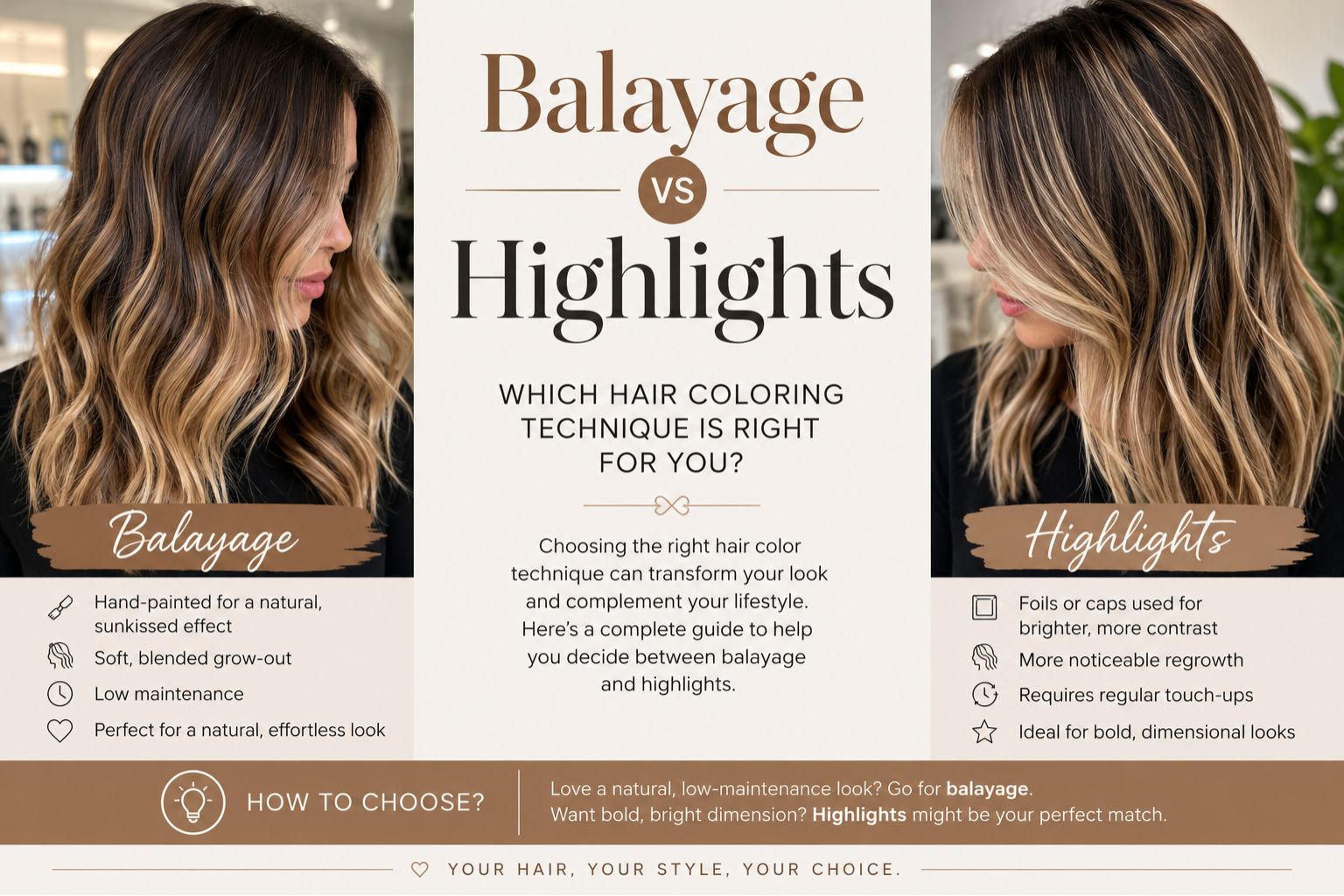


If you are sitting in a Delhi or Mumbai salon, a stylist just asked if you want balayage or highlights, and you feel lost. This hair color choice has a direct impact on your look, upkeep time, and root regrowth. Many women book a session without understanding the core difference between the balayage vs highlights debate, leading to dissatisfaction later. Both are popular in 2026, but they serve different goals. The real difference is not just technique... it is about how each method behaves on natural Indian hair, how often you need to return, and what kind of fade or regrowth you can actually tolerate without getting annoyed.
What Does Balayage Mean For Your Salon Visit?
Balayage is a freehand painting technique where the colorist sweeps the lightener onto the surface of your hair, focusing on mid-lengths and ends. You do not sit with foils on your scalp for an hour. Many first-timers complain about a burning sensation on the scalp during highlights, but balayage avoids that because the product does not touch the root as aggressively. A common non-obvious detail people overlook is that balayage often creates a sun-kissed fade that blends with your natural base, so root touch-ups can be delayed by 3 to 4 months. However, this technique works best on virgin hair or at least hair that has not been heavily bleached recently. On dark Indian hair, the lift may appear warmer or slightly brassy if not toned properly, and that is a boundary some stylists fail to warn about — you end up with orange streaks and wonder what went wrong.
How Highlights Behave On Indian Hair And Scalp
Highlights traditionally involve weaving strands of hair into foils to isolate them from the rest, allowing the color to process with heat from your scalp. This method gives more defined, uniform streaks from root to tip. On Indian skin, the proximity of the foil to the scalp can cause a real salon observation of redness or mild heat during processing. A common misunderstanding causing dissatisfaction is that highlights always look natural. In reality, on low-contrast Indian hair, thick foils can create stripe-like sections if the stylist takes large weaves — it looks less sun-kissed and more, I don't know, like you tried at home. Highlights also demand more frequent salon visits every 4 to 6 weeks because the root growth becomes obvious. For bridal preparation or a busy lifestyle, this timing constraint can become a problem — you are running between office and salon every month.
The Mistake Of Choosing Based Only On Price Or Trend
Many customers book their appointment based on what is trending on Instagram without understanding that balayage is often charged by the hour and highlights by the number of foils. A common mistake is assuming balayage is cheaper. In reality, because balayage requires skilled freehand work and multiple tones, it can cost more initially. However, the total investment over a year may favor balayage because you need fewer salon visits. The service dependency here is your stylist's experience with your specific hair texture. A stylist who is trained on straight European hair may not know how to lift Indian hair without overprocessing — my friend had her hair turn gummy after one session. Another overlooked boundary is that balayage does not cover grey hair well because the color is not applied from the root; highlights are better for grey coverage, simple as that.
How To Decide Based On Your Lifestyle And Maintenance
Your decision should come down to how much time you can realistically spend on salon visits and how you want your regrowth to appear. If you want a low-maintenance, lived-in look that grows out softly, balayage is usually the better choice for Indian women who visit the salon twice a year. If you want bright, even color from root to tip and you are planning a specific event like a wedding, highlights give that polished, uniform result. Many women overlook the fact that their skin condition matters; a known trigger for scalp irritation in foils is sensitive skin. A major service dependency is your hair history. If you have previously used henna or hair dyes, balayage may lift unevenly — it becomes patchy and you start panicking. For confidence in your decision, refer to a trusted beauty blog that breaks down technician styles and real customer feedback. parlourtime connects you with salons that specialize in each technique, so you can book with clarity instead of guessing.
FAQ
-
q Which technique lasts longer between Balayage Vs Highlights?
-
a Balayage lasts longer in terms of regrowth visibility because the color is denser on ends and lighter at roots, meaning you can go 3-4 months between touch-ups. Highlights show obvious regrowth every 4-6 weeks — those white roots show up fast.
-
q Can balayage damage my hair more than highlights?
-
a It depends on your starting hair health. Both use lightener, but balayage often requires stronger formulas to lift through darker Indian hair in one pass, which can cause damage if the stylist rushes. Highlights use multiple applications over time, so it spreads out the stress on your hair.
-
q Which is better for covering grey hair in Indian women?
-
a Highlights are better for grey coverage because the color is applied from root to tip. Balayage skips the roots intentionally, so grey strands near the scalp remain visible unless you add an intermediate base color — which kind of defeats the low-maintenance point.
-
q How much does each technique cost in an Indian salon in 2026?
-
a Highlights are usually a fixed package around 2500 to 5000 rupees. Balayage is charged per hour, often 4000 to 8000 rupees for the session. You can check contact parlourtime salons for current pricing in your city — it varies a lot between metros and smaller cities.