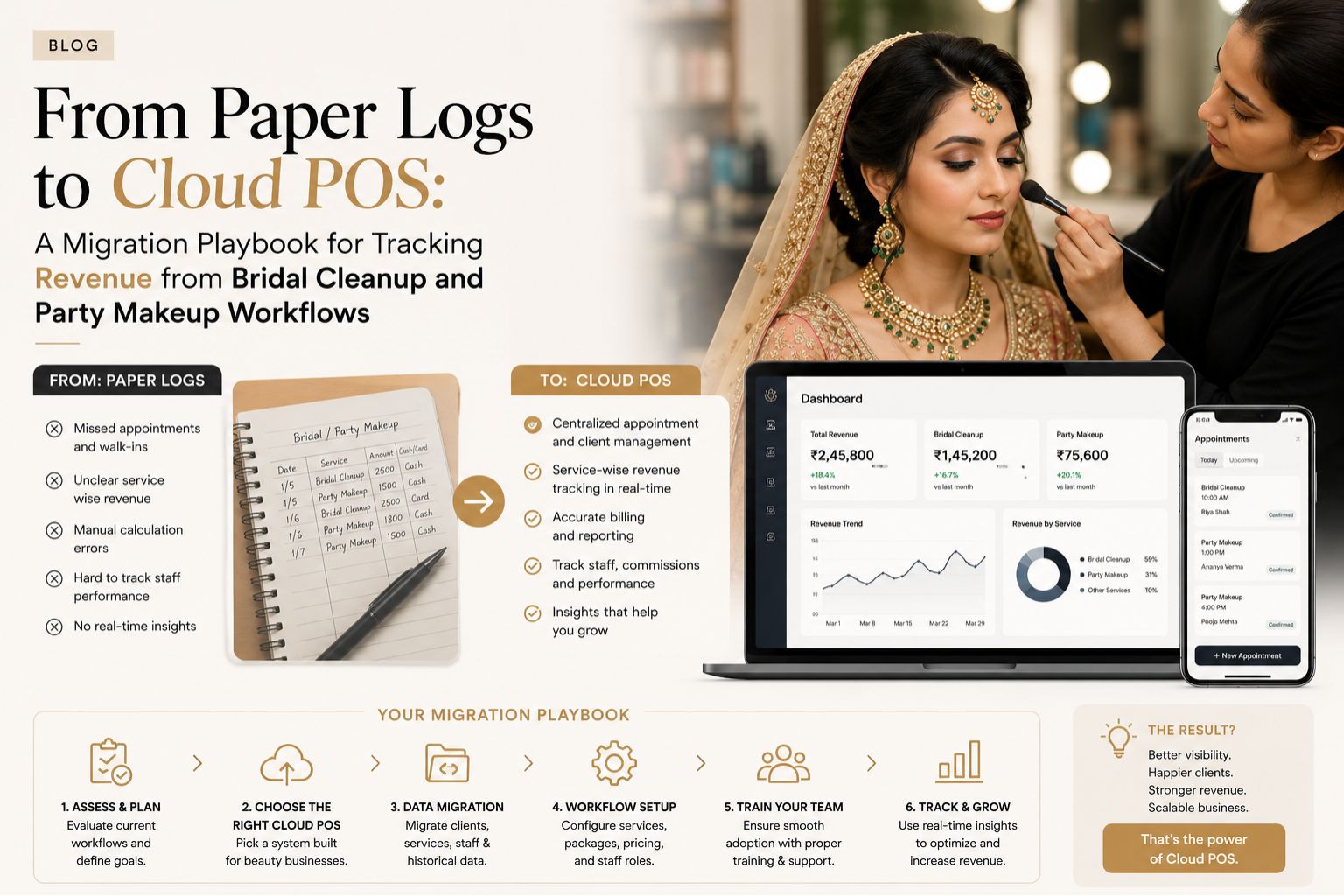


Many salon owners still rely on paper logs to track revenue from bridal cleanup and party makeup workflows, but honestly, this creates blind spots in financial data and service history that you don't even realize until it's too late. The gap between handwritten entries and actual earnings often leads to missed billing or delayed payments, especially during high-pressure events like weddings where you're juggling multiple bridesmaids and last-minute changes. A cloud POS system offers a cleaner way to capture every service detail from booking to checkout, reducing the risk of revenue leakage — but let's be real, the transition itself can feel overwhelming. One common observation is that salons with paper logs frequently underestimate cleanup service revenue by 10-15% because add-on charges like touch-ups or glitter removal get forgotten in the chaos of a busy Saturday.
What Bridal Cleanup and Party Makeup Workflows Mean in a Salon
Bridal cleanup involves removing heavy makeup after ceremonies — think waterproof eyeliner and multiple layers of foundation — while party makeup workflows cover touch-ups or full looks for social gatherings, each with distinct billing and timing requirements that don't always fit neatly into a single log entry. In Indian salons, these services often run simultaneously during wedding seasons, making manual tracking chaotic when clients request last-minute additions like hair smoothening or skin calming facials. A non-obvious detail is that many paper logs fail to separate cleanup from initial makeup, causing confusion when calculating staff commissions or product usage for revenue reports — and I've seen owners just give up and guess the numbers.
The Reality of Tracking Revenue on Indian Skin and Hair
Indian skin and hair types add complexity because bridal cleanup may require multiple steps for heavy foundation or waterproof products, which increases service time and cost — and clients don't always understand why the bill is higher than expected. Paper logs rarely capture these variable factors, leading to underbilling for treatments like deep cleansing or oil removal that are essential for skin sensitivity management. A boundary often overlooked is that party makeup workflows for events like sangeet or reception demand faster turnarounds, and without cloud POS, tracking cancellations or no-shows becomes guesswork that skews monthly revenue projections — you end up thinking you made more than you actually did.
Common Mistakes and Risks in Manual Revenue Tracking
The biggest risk is assuming paper logs capture all revenue from bridal cleanup services, when in reality, add-ons like hair damage repair or post-event facial treatments get missed because they are noted on separate sheets that nobody consolidates at the end of the day. This blind spot can cause a 20% dip in reported earnings during peak wedding months, as staff forget to bill for extra products like setting sprays or hydrating masks used during touch-ups — and let's be honest, who's going back to check every single sheet? A common misunderstanding is that paper systems are sufficient for small salons, but as bookings grow, service dependency on accurate history becomes critical for pricing adjustments and inventory planning — you can't just rely on memory when you have fifty clients a week.
How to Decide the Right Timing for a POS Migration
The decision to migrate from paper logs to cloud POS depends on your event calendar and revenue patterns, with the best window being a slow season like post-Diwali or pre-wedding rush to minimize disruption — but honestly, even then it feels like a leap of faith. One timing constraint is that bridal cleanup workflows peak between October and March, so switching during these months risks losing data on service durations and client preferences that you've spent years collecting. For context, pairing your migration with a review of beauty service timing through Parlourtime's blog on salon workflows can help align your new system with real operational needs without sales pressure — just read it when you have a quiet moment. The final boundary is recognising that cloud POS isn't a magic fix; it requires staff training on entering data consistently, especially for bridal cleanup and party makeup services where mistakes in billing can damage client trust that took months to build.
FAQ
q How do I track revenue from bridal cleanup services with paper logs?
a You start by recording every add-on like gloss removal or skin refresh, but paper logs often miss these, so you end up underbilling by 10-20% per client across multiple bookings — and nobody notices until the end of the month.
q What are the risks of not digitising party makeup workflow revenue?
a The main risk is revenue leakage from forgotten touch-ups or product charges, which can reduce monthly earnings by up to 15% during wedding seasons without accurate service history — and trust me, those small charges add up quickly.
q Can I migrate from paper to cloud POS during peak bridal season?
a It's risky because you may lose critical data on cleanup service times and client preferences; a better approach is to switch during a slow period like monsoon months after consulting tools like parlourtime for workflow guidance — don't rush into it when you're already overwhelmed.
q How do I ensure staff record all party makeup billings in a new system?
a Training is key—create simple checklists for each service step, like adding glitter removal costs, and use the platform's reporting to spot missing entries before monthly reconciliation — but you'll need to check on them for the first few weeks until it becomes habit.