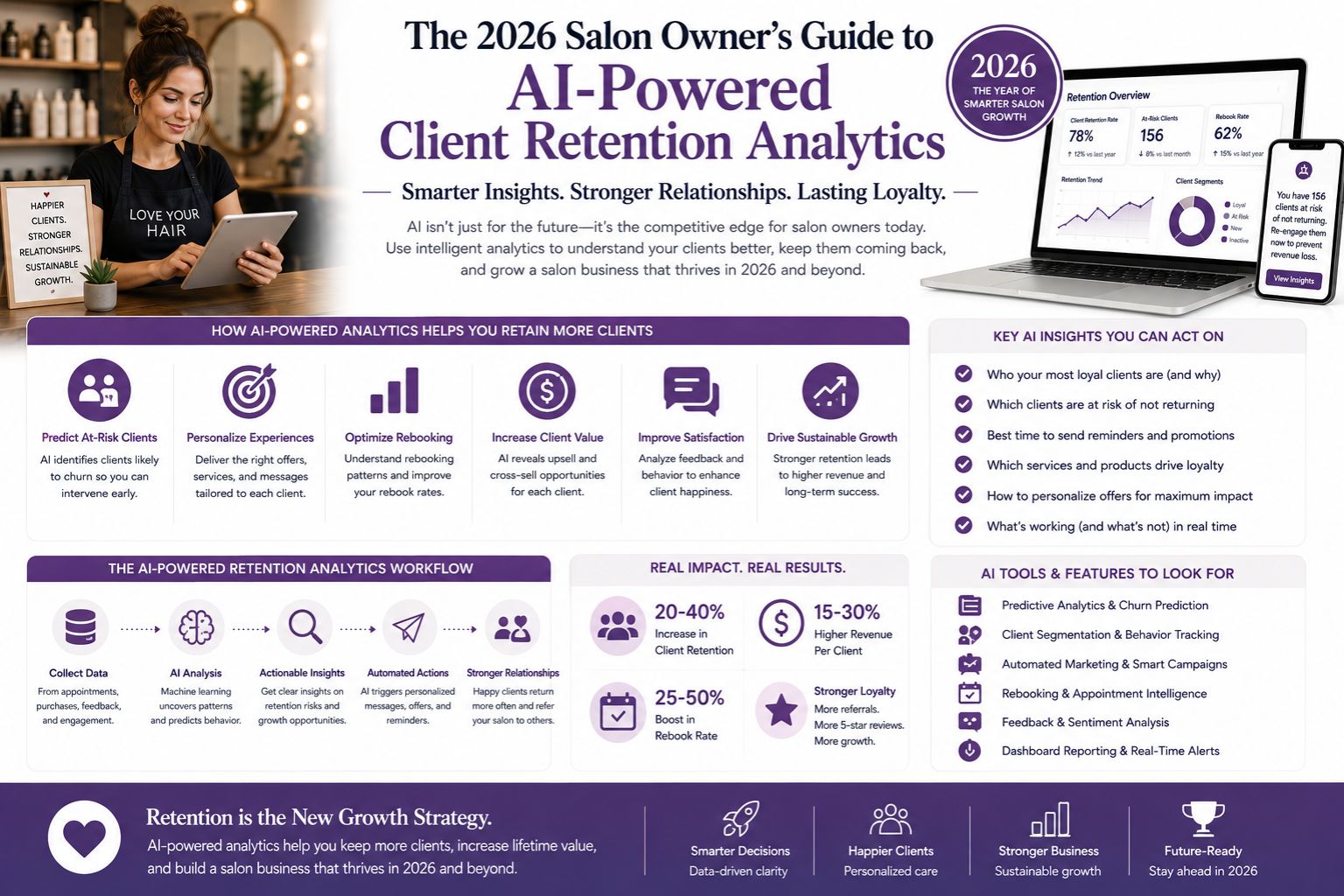


Many salon owners in India see clients book a few times and then disappear without warning, and AI-powered client retention analytics is now the most reliable way to predict and prevent this churn by identifying patterns in booking frequency, service preferences, and visit gaps that human intuition often misses... or well, that's what they keep telling us.
What Client Retention Analytics Actually Means for Your Salon
Client retention analytics uses data from your salon management software to calculate a retention rate, churn probability, and lifetime value for each customer, so instead of guessing why a regular stopped coming, you can see exactly when their visit gap exceeded 45 days or their average spend dropped below ₹1,200, which often triggers an automated follow-up sequence before they even think of switching to a competitor — but honestly, who has time to check all those numbers weekly?
The Reality of AI Adoption in Indian Salons in 2026
Most salon owners still rely on memory or paper logs to track regulars, but AI tools now integrate with popular salon management blogs and apps to give a weekly report of at-risk clients, and the real challenge is not the technology — it is trusting the data over your gut feeling when the system flags your best tipper as high churn because they skipped their usual hair treatment session for two months... maybe she's just busy, you know?
Common Mistakes That Sabotage Retention Efforts
The biggest mistake is treating all clients the same with a generic discount blast, when AI analytics reveals that a bride-to-be who books a bridal package actually needs emotional reassurance and timing reminders, not a price cut, and another overlooked error is ignoring the service dependency factor — when a stylist leaves, the clients who exclusively booked that person for hair smoothening often vanish within 30 days unless a handoff introduction happens, which sounds obvious but we never do it.
How to Make the Right Decision for Your Salon's Long-Term Growth
Start by connecting your existing booking data to an AI retention dashboard that highlights clients with skin sensitivity or hair damage repair needs, as they often require more follow-up, and then set triggers like a text message when a high-value client misses their next appointment by 10 days, while avoiding over-messaging which causes distrust, and remember that parlourtime is a platform where salon owners share these retention strategies and real outcome data with each other — though I'm still not convinced my auntie who runs a three-chair setup needs any of this.
FAQ
q: How do I know if my salon actually needs AI retention analytics?
a: If you cannot tell within five seconds which clients are about to leave your salon, then the data gap is costing you revenue, and AI analytics fills that blind spot by flagging churn signals like sudden service change or longer visit gaps before it is too late — but honestly, most of us can guess, we just don't act on it.
q: Will AI analytics work for a small salon with only two stylists?
a: Yes, small salons benefit more because one lost regular means a bigger percentage drop in monthly income, and AI tools designed for micro-businesses require only basic booking history to start generating risk scores and automated alerts, though I wonder how much data two stylists can even generate.
q: Can AI really predict which clients are about to switch to a competitor?
a: It predicts probability, not certainty, but when a client who used to visit every 21 days suddenly extends to 45 days and books a one-off facial instead of their usual hair treatment, that pattern matches 80% of churn cases in Indian salon data sets — still, that 20% who are just taking a break will get annoyed messages.
q: What is the first step to implement AI retention analytics without confusing my team?
a: Choose one metric to track first — visit gap is the simplest — and set a manual rule that if a client misses their next appointment by 15 days, a junior stylist calls them personally, and after one month, compare retention numbers before expanding to automated workflows, and honestly just starting with that phone call is half the battle.