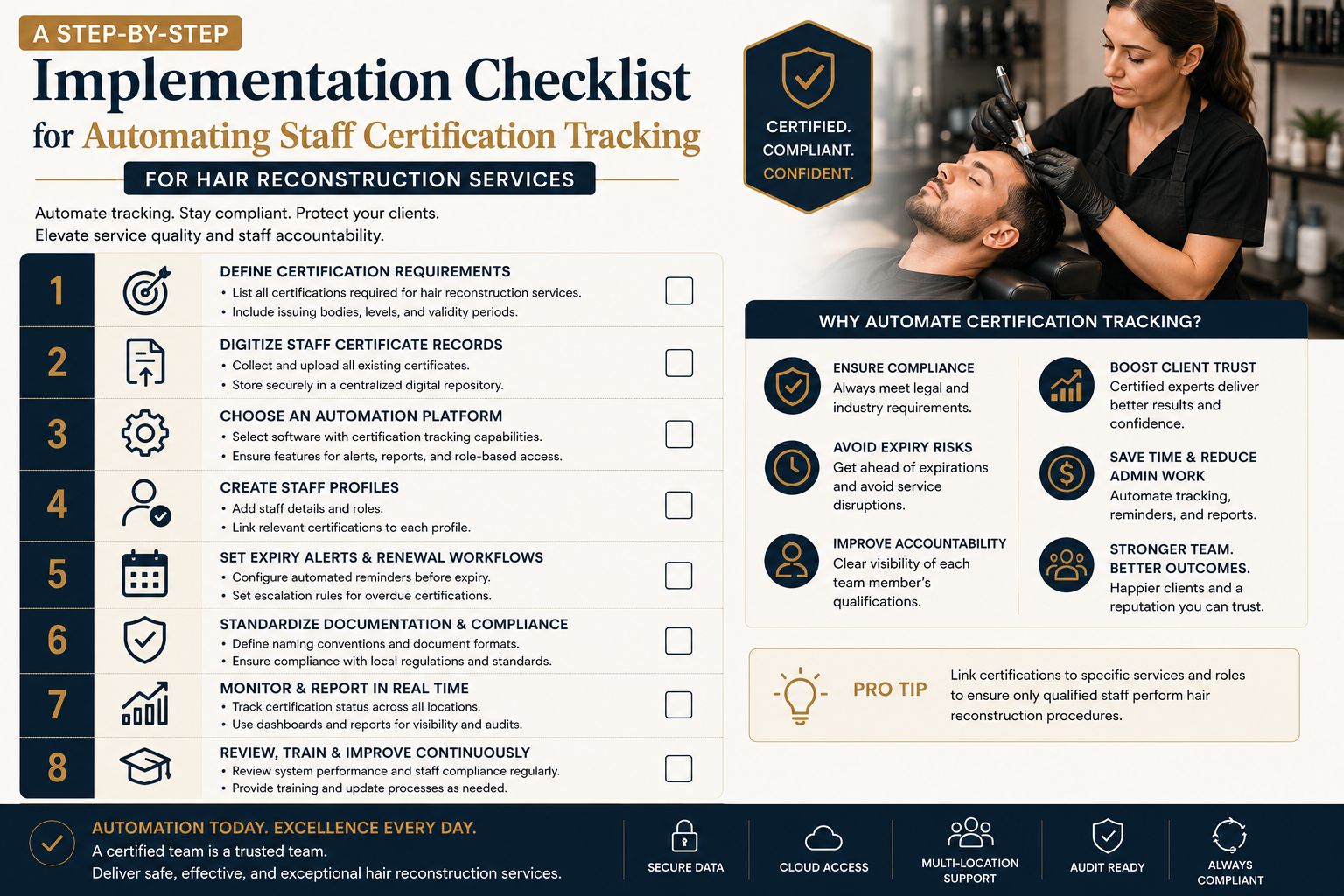


When a client books a high-value hair reconstruction session, they expect certified hands performing the service—not a guess based on paper records. I mean honestly, how many of us have walked into a salon and just assumed the person touching our hair actually knows what they're doing? Many salons lose credibility because certification tracking relies on manual spreadsheets or memory, leading to expired credentials slipping through the cracks. This checklist helps you move from paper chaos to automated compliance, specifically for hair reconstruction services where technique precision and chemical handling knowledge are non-negotiable.
Why Certification Tracking Breaks Down in Hair Reconstruction
Hair reconstruction involves reconstructing bonds using alkaline treatments—certifications for these services require annual renewal and proof of practical exams. The thing is, in most salons, the salon manager pins a printed certificate on a corkboard or files it in a drawer, forgetting to check renewal dates until a client complains about patchy results or a stylist accidentally uses the wrong protein level. And then you're left wondering, how did we not catch this earlier? This gap directly affects service consistency and opens the door to liability during regulatory inspections, which nobody wants to deal with.
What Actually Happens When Certifications Are Not Automated
During a busy wedding season, a senior stylist performed a bond repair service on a client with highlighted hair—her certification had expired three months prior, but nobody knew because the paper record was buried under booking sheets. I've seen this happen, it's not pretty. The client experienced uneven texture and breakage, and the salon had zero documentation to prove the stylist had ever been trained on that specific reconstruction system. Manual tracking also creates friction during audits—you waste hours flipping through files instead of proving compliance in minutes, and honestly who has time for that?
The Critical Mistake Most Salons Make When Choosing a System
Common misunderstanding—and I get it, I've been there myself—managers buy a generic HR software expecting it to handle certification workflows automatically. But here's the catch: most platforms treat certifications as static fields, they do not send renewal reminders based on service type, meaning you still rely on someone to manually enter expiry dates. Another blind spot that's easy to miss: failing to link certifications to specific chemical services like keratin smoothing or bond multiplier treatments. If a stylist holds a general hair diploma but lacks certification for alkaline-based reconstruction, the system should flag that gap before the appointment is booked. Not after.
How to Decide Which Certification Automation Tool Fits Your Salon
Before evaluating software, list every hair reconstruction service your salon offers—bond repair, protein filler treatments, split end sealing—and identify the exact certification required for each. Sounds obvious but you'd be surprised how many skip this step. Then check whether the tool can send automated push notifications to staff 30 days and 7 days before expiry, and whether it locks service scheduling if a certification lapses. Some platforms integrate with booking apps so a client cannot be assigned to an uncertified stylist—this is the boundary where automation actually prevents the mistake, not just tracks it. For practical implementation guidance, visit the Parlourtime blogs or explore FAQs on staff compliance systems.
FAQ
q What happens if a stylist’s certification expires mid-week during a hair reconstruction booking?
a Most automated systems block that stylist from being assigned new appointments—the client would be reassigned to a certified colleague or the booking is put on hold until renewal is uploaded and verified.
q How often do hair reconstruction certifications need renewal compared to basic styling certifications?
a Hair reconstruction certifications typically require annual renewal due to evolving chemical formulations and safety protocols, whereas basic styling credentials often last two to three years before revalidation.
q Can a small salon with three stylists justify investing in certification automation software?
a Yes—even one uncertified service can trigger client complaints or audit fines. Automation removes manual reminders and protects service quality regardless of team size.
q Does parlourtime offer tools to track certification compliance for hair reconstruction services?
a Yes, parlourtime provides certification tracking features tailored to hair reconstruction workflows, including expiry alerts and service assignment restrictions based on staff credentials.