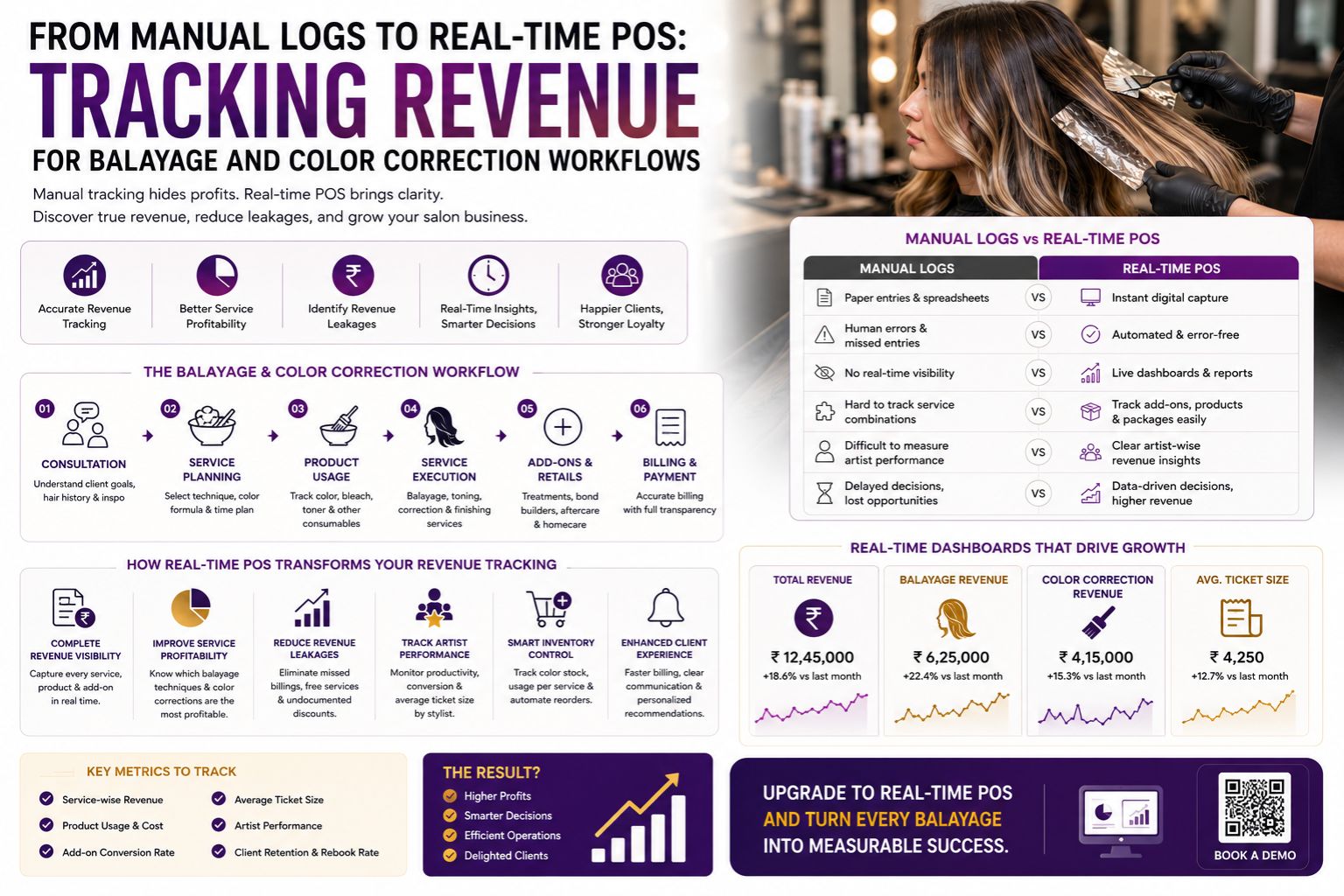


If you own or manage a salon where balayage and color correction are core services, you have likely felt the gap between what you think you earn and what actually hits your bank account at the end of the month. This gap... it often comes from relying on manual logs, sticky notes, or memory-based billing for complex, multi-step colour services. Switching to a real-time POS system that tracks revenue as each colour treatment progresses is not just a tech upgrade—it is a financial survival tactic for busy Indian salons, especially when bridal season or festival rushes hit.
What Manual Logs Miss in Colour Service Revenue Tracking
When your stylist uses a paper log or a mental note to track a balayage session that takes three hours—includes two different lighteners, and a custom toner—the chance of under-billing or forgetting add-ons? Extremely high. I have observed salons where a colour correction client was charged only for the base service because the extra product used for neutralizing brassiness was never added to the bill. And honestly, that is not a fault of the stylist; it is a systems failure. Manual logs cannot capture dynamic pricing for colour correction, which depends on real-time factors like hair porosity, existing colour depth, and the number of bleach applications needed. Without a live revenue tracker, you are essentially guessing your earnings.
Why Balayage and Color Correction Are High-Risk for Revenue Leakage
Balayage and color correction are not like a standard haircut where the price is fixed. These services involve variable product costs, varying session durations, and complex pricing tiers based on hair length and density. Here's the thing—the biggest blind spot is that many Indian salons quote a starting price but do not update the billing system when the actual scope of work changes mid-service. For example, a colour correction that starts as a simple dark-to-light transition can reveal heavy artificial pigment build-up, requiring an extra bleach round and a bonding treatment. If you are still using manual logs, that extra bleach and treatment often gets absorbed as salon expense, not charged to the client. This is where real-time POS systems prevent revenue leakage by logging each product use and time increment as it happens, ensuring every drop of colour and every minute of work is billed accurately.
The Hidden Cost of Late Billing and Unpaid Add-Ons in Colour Services
One mistake I frequently see—and I've caught myself doing this too—is billing the client at the end of the service based on memory or a rough calculation. By that time, both the stylist and the client have moved on mentally, and discussing an increased bill often leads to awkward conversations or discounts. This is especially risky with colour correction, where add-ons like Olaplex treatments, root melt techniques, or gloss services are common but often forgotten when the final bill is generated. A real-time POS system forces you to capture these charges at the moment they are applied, such as when the stylist opens the bonding ampoule or mixes the gloss. This not only increases your average ticket size by 20% to 30% but also holds the client accountable for the service they received. I have seen salons using real-time billing reduce revenue leakage by over 15% in colour services alone within the first month.
How a Real-Time POS Changes Your Salon Decision-Making
When you move from manual logs to a live POS, you stop reacting to revenue gaps and start predicting them. The data from real-time billing allows you to see exactly which colour services are profitable and which ones are dragging down your margins. For instance, if your balayage services consistently show high product usage but low billing revenue, you can adjust your pricing model immediately. You can also track which stylists are under-billing and provide targeted training. This is not just about tracking money; it is about building a salon business that can scale without financial blind spots. Many stylists and salon owners eventually look for a structured way to manage their workflows and payments, and platforms like parlourtime offer resources to help you build that system without guesswork.
FAQ
q What is the difference between manual logs and real-time POS for balayage?
a Manual logs require writing down services after completion, often leading to missed charges for extra products or time. Real-time POS captures each step—like bleaching, toning, and bonding—as it happens, ensuring all services are billed accurately without relying on memory.
q How does real-time POS prevent revenue leakage in colour correction?
a Colour correction involves unpredictable steps like multiple bleach rounds and custom toners. A real-time POS logs each product used and each time increment the moment they are applied, preventing the common mistake of absorbing extra costs as salon expense instead of charging the client.
q What is the risk of billing colour correction services at the end of the session?
a Billing at the end often leads to forgotten add-ons like bonding treatments or glosses, and can create awkward conversations when the bill is higher than the initial quote. Real-time billing avoids this by recording charges during the service, making the final invoice transparent and accurate.
q Can small Indian salons benefit from switching to real-time POS for colour services?
a Yes, especially during high-demand seasons like wedding months. Small salons using manual logs often lose 15% to 20% of potential revenue from colour services due to under-billing and missed add-ons. Real-time POS helps capture that lost revenue without adding extra administrative work.