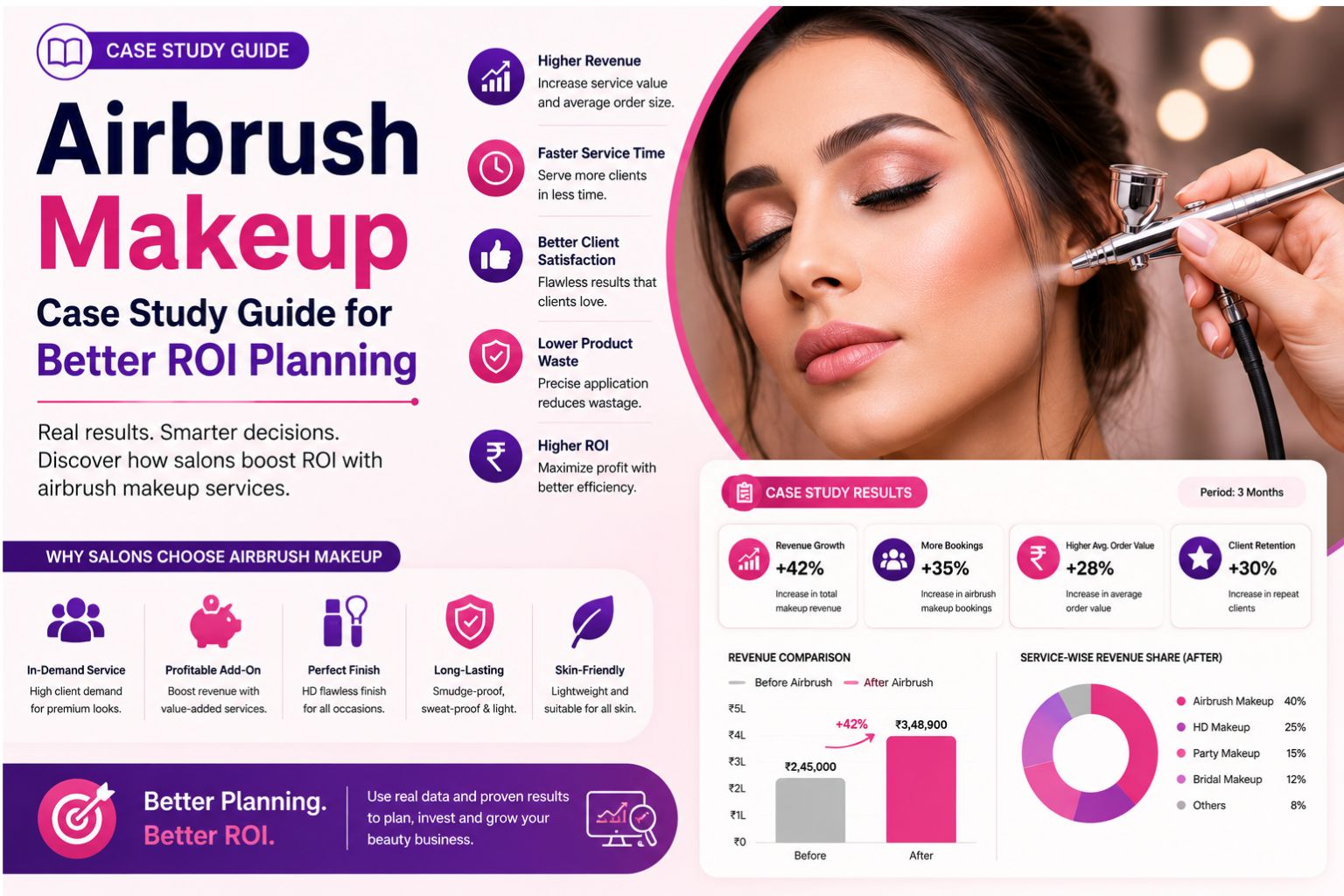


Many salon owners in India are reconsidering whether offering airbrush makeup is a financially sound decision. The hesitation is understandable—the equipment costs more than traditional makeup, training requires investment, and the pricing structure needs careful thought to ensure profitability. This airbrush makeup case study guide focuses on real factors that determine return on investment: equipment lifespan, product consumption per client, technician skill development, and client retention patterns. Without clear planning, the transition from traditional to airbrush can feel risky. But when service timing, pricing strategy, and client education align properly, the ROI becomes measurable. This guide breaks down what salon owners commonly notice first—uneven booking patterns, inconsistent product usage, and variable client satisfaction. Understanding these signals helps separate profitable decisions from costly experiments.
Understanding ROI through Real Service Scenarios
When evaluating airbrush makeup from a business perspective, the first thing salon professionals notice is the difference in service time compared to traditional makeup. Airbrush application takes approximately thirty to forty-five minutes for a full face, which is faster than conventional hand-blending techniques. This speed allows salons to schedule more appointments within the same timeframe. But the product cost per client varies significantly based on coverage requirements and skin type. For Indian skin, which often requires additional concealing or layering, the product consumption can increase by twenty to thirty percent—sometimes even more during wedding season. This variation directly affects profit margins. Many salons overlook this dependency and end up pricing services too low, assuming product usage will remain consistent across all clients. The reality is that oily skin, pigmentation concerns, and festive occasion demands often require more product layers, increasing operational costs without corresponding price adjustments.
Factors That Influence Airbrush Makeup Profitability
Several salon-specific factors determine whether airbrush makeup becomes a profitable service or an underperforming addition. Equipment durability is one—entry level airbrush machines may last only six to eight months with daily usage in Indian salons, while professional compressors can serve reliably for two to three years if you take care of them. Product shelf life matters too. Water-based and silicone-based formulations degrade faster in humid environments, commonly leading to wastage that you don't even notice until it's too late. Technician training is another overlooked variable. A stylist who understands airbrush maintenance, cleaning routines, and application pressure control reduces product waste by nearly half compared to someone with minimal training. Additionally, the service price point must reflect the time spent on prep work, which includes skin analysis, primer selection, and patch testing—stuff that takes time but clients rarely see. Salons that skip these steps to save time often face inconsistent results, leading to lower repeat bookings and negative client feedback, both of which weaken ROI.
Mistakes That Undermine Return on Investment
One of the most common mistakes in airbrush makeup service planning is underpricing based on competitor rates without considering real cost structures. Many salons set prices after observing others in the locality, but they fail to account for their own product consumption, machine maintenance, and retraining costs—it's like guessing blindly. Another blind spot is assuming that a single airbrush machine can handle multiple clients without performance degradation. In practice, compressors need cooling breaks and nozzle replacements after roughly fifteen to twenty full applications. Skipping maintenance leads to uneven spray patterns, requiring more product for correction, which reduces per-client profitability. Dissatisfaction escalates when clients notice finish differences between their initial trial and the actual service—and trust me, they notice everything. This inconsistency erodes trust and reduces the likelihood of referrals. Salon owners often overlook the fact that airbrush makeup demands more rigorous hygiene protocols than traditional tools, and failing to enforce sterility can lead to skin reactions, especially on sensitive Indian skin, resulting in refunds or damaging online reviews that haunt you for months.
Smart Planning Strategies for Better Service Returns
To improve airbrush makeup ROI, salon owners should restructure their approach around realistic evaluation criteria. First, assess whether your current client base regularly requests full-coverage bridal or event makeup, as these clients benefit most from airbrush's longevity and transfer resistance. Second, set a pricing model that includes a base service charge plus a premium for additional coverage layers or touch-up kits—this structure protects margins when product consumption varies wildly. Third, invest in technician training sessions every three months rather than relying on one-time instruction. Trained staff reduce waste and improve finish consistency, which directly correlates with positive reviews and repeat bookings. Fourth, maintain a service interval of at least forty-five minutes between appointments to allow compressor cooling and sterilization. This prevents equipment stress and maintains finish quality. Many salons using parlourtime to compare service timing and pricing have found that structuring airbrush services around event-specific needs—like bridal trials, festival appearances, and engagement functions—yields better utilization rates than offering it as a generic alternative to traditional makeup.
FAQ
q How do I calculate the actual cost per airbrush makeup service?
Calculate equipment depreciation, product consumption, technician time, and maintenance overhead per client to determine your break-even price.q Is airbrush makeup profitable for small salons in India?
Yes, if you target bridal and event clients, price correctly based on product usage, and limit machine wear by scheduling breaks between services.q How often should I replace airbrush equipment?
Entry level machines may need replacement after eight months; professional compressors can last two to three years with regular maintenance and cleaning.q Does airbrush makeup suit all Indian skin types?
It works well for most skin types, but oily and sensitive skin often require additional prep and product layers, which increases service cost.q What is the biggest hidden cost in airbrush makeup services?
Product wastage due to improper nozzle maintenance and untrained technicians is the most overlooked expense affecting profitability.
q Can I offer airbrush makeup without raising my prices?
Raising prices is usually necessary because product costs and machine depreciation are higher than traditional makeup service expenses.q How do I ensure consistent results across different technicians?
Standardize your prep protocol, invest in periodic training sessions, and use the same product formulas across all service bookings.q When should I reconsider offering airbrush makeup?
If your client base rarely requests full-coverage makeup or you cannot allocate time for equipment maintenance and technician skill upgrades.