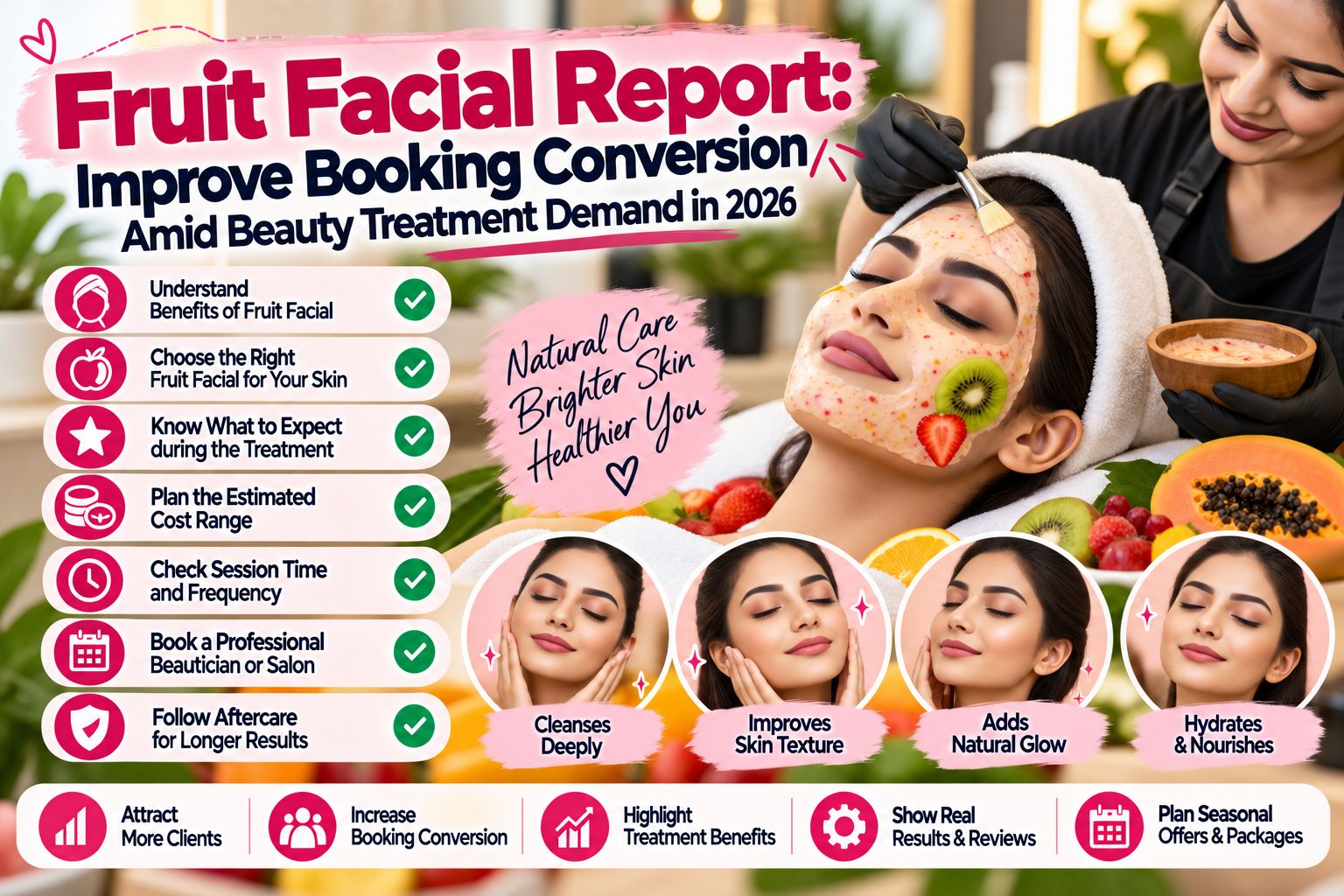


A fruit facial report for operators is not about the mask on the trolley. It is about the funnel that carries a curious customer from first inquiry to a confirmed appointment. Fruit facial booking conversion means the share of people who ask about the service and actually confirm a slot. It stalls when the treatment menu is vague, pricing stays hidden, availability is fuzzy, and the deposit step feels like a hurdle. The single most useful lever is a treatment-specific page that answers price, duration, and next open slots on the spot.
A fruit facial uses fruit-derived enzymes or acids, such as papaya or pineapple, to exfoliate and refresh the skin. It sits near a hydrating facial on a salon menu, and it is usually a different service from a chemical peel, which works with stronger acids. Customers often ask for a fruit facial by name, so the inquiry that reaches your desk is already specific. What follows is where most operators lose the booking.
What the fruit facial booking journey looks like from inquiry to confirmation
The funnel has six visible steps, and each one leaks a little. A person sees the service, sends a message or calls, asks about price, checks whether a slot fits their week, hears about the deposit, and confirms. Operators who treat these as separate hurdles fix them one at a time. Operators who treat them as one blob of "enquiries" rarely see where the loss happens.
One operational observation from working these funnels: most stalls happen at the price and availability step, not at the deposit. If a customer has to ask "how much" and wait for a reply, the interest cools. If they have to ask "when" and wait again, the interest usually goes cold.
Step one: the treatment-specific landing page
A generic services page listing every facial in one block gives the fruit facial no room to breathe. A single page that names the treatment, states what it targets, shows who it suits, and clarifies what it is not, filters out mismatched inquiries before they arrive. That reduces the back-and-forth.
Keep the page short. One image of the actual service, one line on duration, one line on aftercare expectations your staff is trained to give, and one clear next action. When a reader can answer most of their own questions on the page, the inquiry that arrives is further along the funnel.
Step two: pricing visibility and what it fixes
Hidden pricing pushes a customer to ask before they commit, and that ask is a natural drop-off point. It also invites comparison shopping in private, where your salon has no presence. Visible pricing on the treatment page is the cleaner option, provided the price reflects the service your team actually delivers.
Where local market conditions make a single number difficult, a clear starting range plus a note on what changes it does the same job. The decision boundary here is simple: if your team cannot defend the number over the phone in one sentence, it is not ready to publish.
Step three: availability display and the deposit flow
Availability that only exists behind a phone call adds a second drop-off. A visible weekly pattern, even a rough one, tells a customer whether the service fits their calendar before they invest effort in the conversation. Slot fill rates tend to improve when the gap between "I am interested" and "I can see when" is short.
The deposit is where operator opinions split. A small deposit reduces no-shows on peak days and signals seriousness from the customer. It also adds one more step and can cost a booking when the deposit method is clumsy. The boundary: use a deposit where your no-show cost is real and predictable, and keep the payment step short. Hair salons often use deposits for long colour appointments for exactly this reason. A vendor with a managed-review workflow may describe deposit policy as a trust-building step, and that reading is fair, provided the refund rule is stated on the same page.
Some operators refine this timing against general beauty guidance before they confirm a policy.
Step four: cutting friction at the confirmation message
Confirmation friction is the last leak and the easiest to fix. A confirmation message that repeats the service, price, date, time, address, and what to bring removes the follow-up questions that delay a yes. A message that only says "slot confirmed" invites doubt.
A short prep line helps too, such as asking the customer to arrive with a clean face and to mention any recent treatments. It sets the service up before the customer walks in and reduces surprises at the chair. When the customer is unsure what to expect, checking beauty service questions before confirming a slot often settles their hesitation.
- Fruit facial booking conversion is a funnel problem, not a demand problem.
- The worst stalls sit at price and availability, not at the deposit.
- A treatment-specific page does more for conversion than a general services list.
- A confirmation message that repeats service, price, and timing prevents last-minute doubt.
- Deposits cut no-shows where the cost is real and disappear when the step is clumsy.
- If the same step keeps leaking, change the step, not the price.
Written by: Parlour Time Editorial Desk
Published: 04 October 2026, 12:22 AM IST | Updated: 04 October 2026, 12:22 AM IST
Powered by: Parlour Time