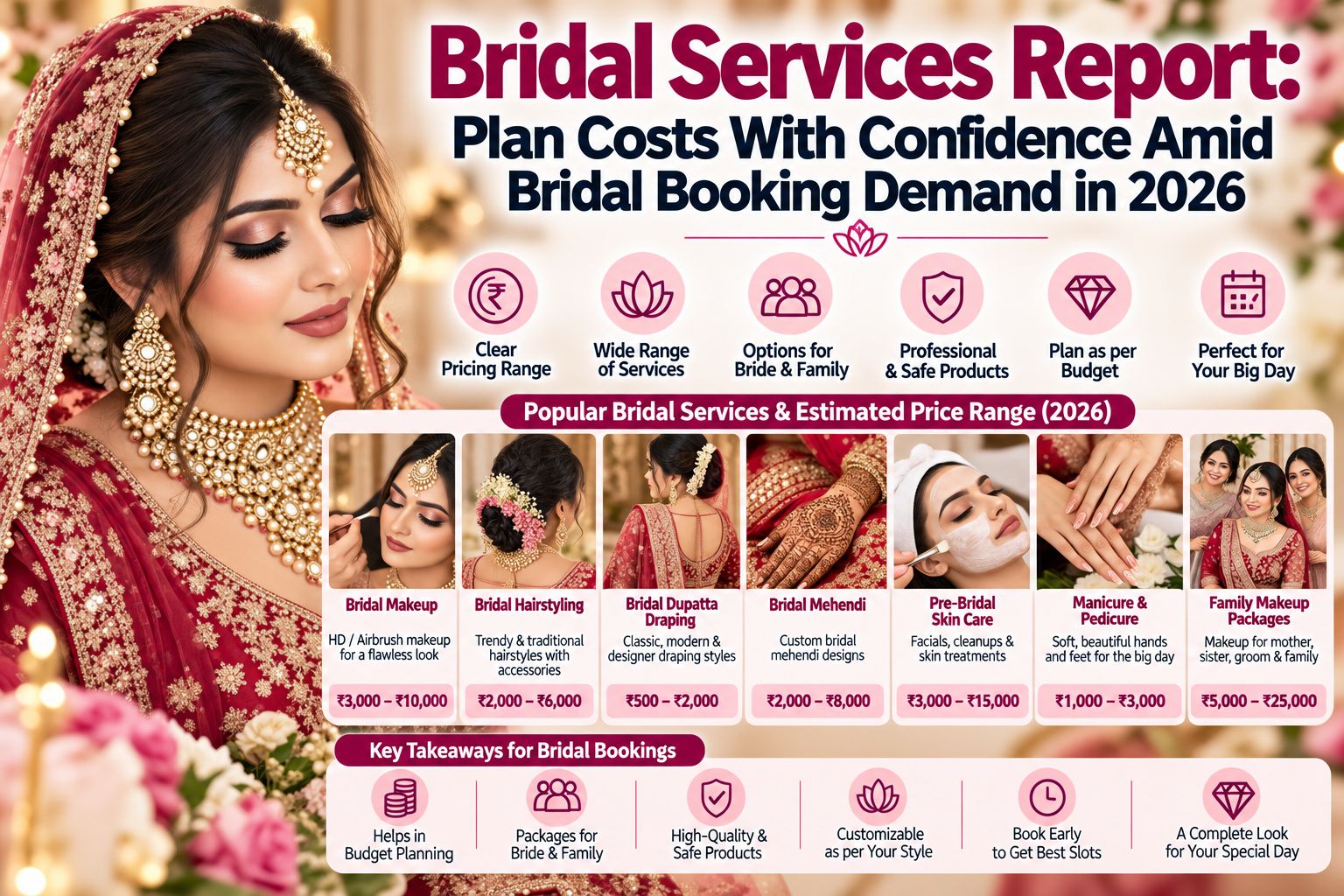


You can plan bridal beauty costs instead of guessing them by splitting the total into clear service categories, fixing your booking timing, and keeping a separate contingency. That approach works even when your wedding falls in a busy window, because you are not trying to predict anyone else's prices. You are controlling what you can decide yourself: scope, number of functions, travel distance, whether you want a trial, and how much buffer you set aside. This guide gives you that framework, not a set of fixed figures.
Start with cost categories you can fill in yourself
Most bridal budgets fall apart because everything sits in one lump line. Break it into categories and the picture gets clearer. Use the list below as an editable framework and fill in your own quotes.
Bridal hair and makeup for the main day
Additional function looks, such as mehendi, sangeet, or reception
Pre-bridal skin and hair services before the wedding
Bridal trial session, if the salon offers one
Travel and outstation charges for the artist or team
Draping, extensions, accessories, or touch-up kits
Contingency buffer, kept separate and untouched
Two practical points matter here. First, ask each salon to quote category by category rather than as one total, so you can compare like for like. Second, treat the contingency as a real line, not a leftover. A buffer of your own choosing, held back until the final week, absorbs small additions without forcing you to drop something you actually wanted.
Compare booking windows on your lead time, not on market talk
No reliable public data was available to confirm how 2026 booking demand behaves, and this guide will not invent figures for you. Instead, compare your own options side by side. The useful dimensions are the ones you already know: how many weeks you have, how many services you need, how far the venue sits from the salon or artist, and whether you want a trial. A decision boundary helps too. If your lead time is short and your list of services is long, cutting scope will help you more than paying to compress the schedule.
Early commitment window means you have more weeks than services, so you can space pre-bridal treatments, book a trial without rushing, and still negotiate scope calmly. The risk is paying an advance before you have confirmed what the package covers.
Moderate window means the timeline fits the essentials but leaves little room for extras. Prioritise the main-day look and one pre-bridal routine, and drop anything that needs a recovery period.
Tight window means there is no buffer left. Keep the plan simple, confirm travel arrangements first since those are hardest to change, and avoid adding new treatments late.
One operational observation worth carrying into every conversation: the number of functions usually changes the cost more than the choice of any single treatment, because each function needs its own look and its own time slot.
Map treatments against your own timeline
Once your categories and window are set, place each service against your calendar working backwards from the wedding date. Advanced treatments need more recovery room than simple ones, so they belong earlier. A trial, if you want one, sits between your final decision on the look and the main day, so your artist has time to adjust.
If your skin or scalp has reacted badly to a service before, mention it at the consultation and ask what will be changed. For any chemical service, including colour, smoothening, or keratin-type work, ask about a patch test before the appointment. A salon that treats this step as routine is easier to work with than one that waves it away. If irritation or unusual hair fall continues after a service, stopping and getting a professional opinion is more useful than repeating the same treatment. You can read general beauty guidance to understand how service spacing affects preparation, and check salon FAQs for how packages are usually structured before you pay anything.
Build the numbers without pretending they are fixed
Write the framework down, then fill it with the actual quotes you collect. For each category, note the amount, what it covers, and whether it depends on something you have not confirmed yet, such as the number of functions or the venue distance. Leave a blank beside anything the salon cannot confirm in writing. That blank is not a failure of planning. It tells you exactly where the risk sits.
Next, add your contingency on top of the completed total, not inside it. If a quote later rises, you decide from your buffer rather than from the money you had already assigned. Keep two numbers visible at all times: your expected total and your maximum, which is the expected total plus the buffer. Any quote above the maximum is a stop-and-rethink signal, not something to absorb quietly.
Pre-booking checks to run before you pay an advance
Run through this short list before any payment leaves your hands. It takes a few minutes and prevents most of the confusion that shows up later.
Scope in writing confirm what the package includes, what is billed separately, and how many people are covered on the day.
Number of functions ask how the price changes for each additional function, and get that in the quote, not in conversation.
Travel charges confirm whether outstation travel, stay, and early reporting hours carry extra cost.
Patch test terms ask when it happens and whether it costs anything on its own.
Trial arrangement confirm whether the trial is included, optional, or charged separately, and whether it counts towards the final booking.
Change and cancellation terms ask what happens if you change the date, reduce the scope, or cancel, and how much of the advance is refundable.
Contingency line decide your buffer amount and keep it out of the total you are willing to spend.
Bridal planning gets easier when you treat it as a budgeting exercise rather than a guessing game. Fix the categories, choose your window honestly, confirm the small print, and hold a buffer back. Whatever the booking season brings, those four habits keep the cost within your control.
Written by: Parlour Time Editorial Desk
Published: 30 September 2026, 10:07 PM IST | Updated: 30 September 2026, 10:07 PM IST
Powered by: Parlour Time