

For a multi-location spa owner or manager, the choice between an AI scheduling tool and traditional booking software... honestly, it comes down to how you handle real-time complexity. Traditional systems might work fine for a single desk, but across multiple branches? They can really struggle with double bookings, staff who split their time across sites, and those last-minute changes that always happen. I was watching a manager recently—she was manually reconciling three paper diaries from different branches—and it just hit me: the old system is breaking under the weight of scale.
What AI Scheduling Actually Changes for Multi-Location Spas
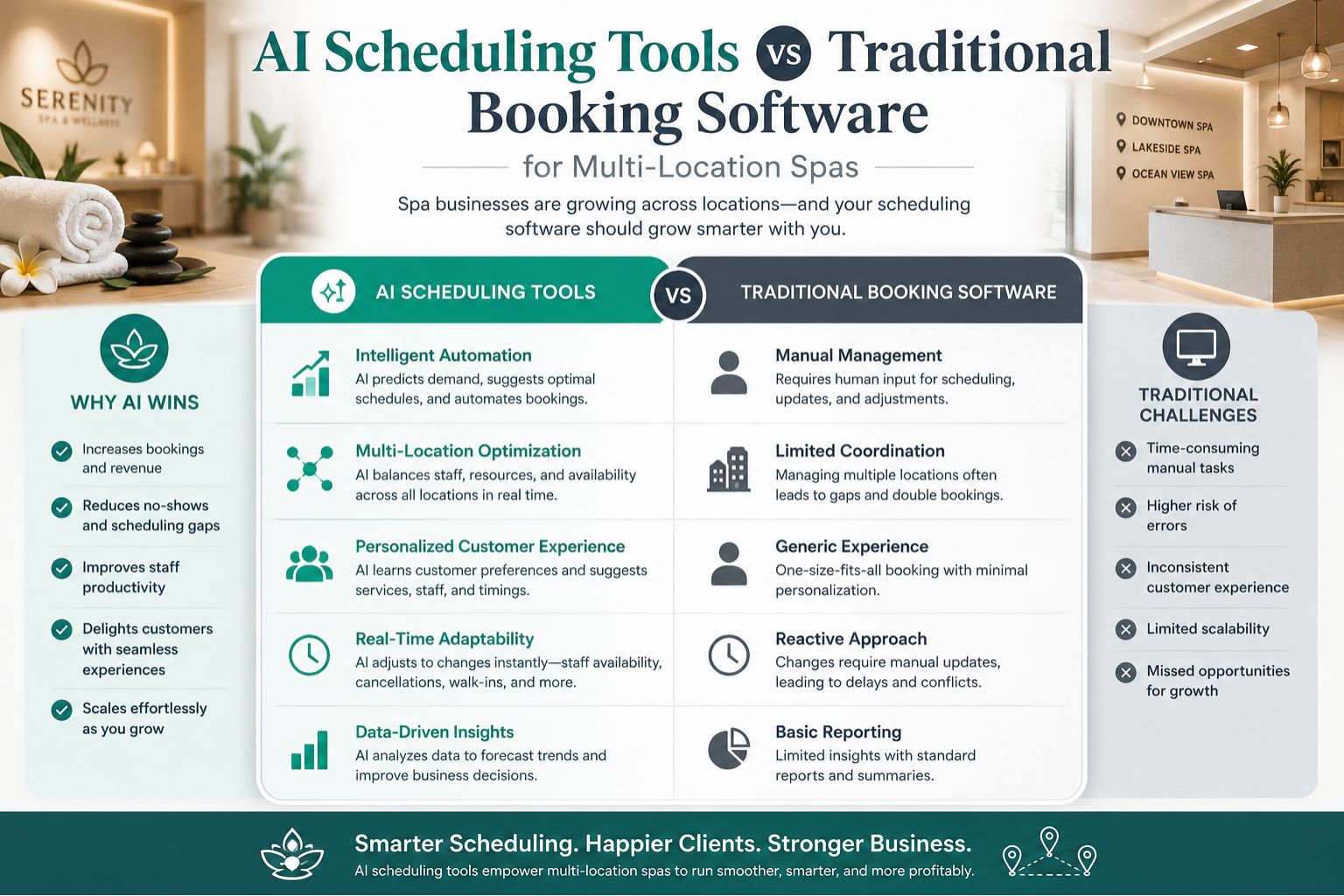
AI scheduling tools do more than just set appointment slots—they actually learn from your historical data. They can predict which time slots will be busiest based on season, location, and even local events happening nearby. One thing people don't always think about: AI can automatically detect and block overlapping bookings when a therapist works at two different branches in one day. In traditional software, that's something you'd have to check manually, and it's a pain. This prevents the whole frustrating experience of a client arriving at one spa only to find their preferred therapist is at another location entirely.
Why Traditional Booking Software Still Dominates in Simplicity
For many single-location or small chain spas—like, you know, places that aren't too big—traditional booking software is still the workhorse. It's straightforward to set up, staff don't need much training, and the costs? Predictable. But honestly, the limitations become really obvious when you try to scale. A common mistake people make is thinking that just adding a "multi-location" filter to traditional software solves everything. In reality, these systems often don't have a unified database, so client history, package balances, and preferences get siloed per branch. That leads to poor service continuity when a customer visits a different location for a bridal preparation package—they end up repeating everything.
The Hidden Risk of Poorly Implemented AI Scheduling
Rushing to adopt AI scheduling without cleaning your data first? That can create more chaos than a manual system, believe me. I saw this happen recently during a transition: the AI model misinterpreted a seasonal spike in hair treatment requests as permanent demand, so it allocated too many slots for basic facials during peak months. Completely off. Another thing nobody warns you about—AI tools can sometimes over-optimize for profit, booking back-to-back deep tissue massages with no buffer. That leads to therapist burnout and lower service quality. It's that boundary where the technology stops working for your team.
How to Decide Between AI and Traditional Software for Your Spas
The decision really depends on what your biggest operational pain point is. If your main struggle is reducing no-shows and optimizing daily schedules, an AI tool that integrates with your current software can be a powerful addition. But if the core challenge is that staff can't consistently check availability across branches or manage a shared client database... then upgrading to a robust, cloud-based traditional software gives you a more stable foundation. For many multi-location spas, honestly, the smartest path isn't picking one or the other—it's a hybrid approach. Use traditional software for core stability and add a targeted AI add-on for predictive booking logic. Platforms like parlourtime support this kind of strategy by providing a unified interface for managing your entire spa network.
FAQ
q: What are the first signs that my spa needs to upgrade from traditional booking software?
a: Recurring double bookings across branches, staff unable to see schedules at other locations, and clients complaining about lost booking history or package balances when visiting a different branch.
q: Can AI scheduling tools fully automate my spa's calendar without human errors?
a: No, they are best used for optimization and prediction, not full automation. Human oversight is still required to handle unique requests, emergency cancellations, and specific therapist-client relationships.
q: How much time does AI scheduling typically save for a multi-location spa manager?
a: Reports often indicate a 30-50% reduction in time spent on manual schedule adjustments, rebooking for cancellations, and resolving booking conflicts, allowing managers to focus on service quality and staff management.
q: Is AI scheduling more expensive or affordable than traditional software for a chain of three spas?
a: The upfront cost is usually higher for AI-driven tools, but the long-term savings from reduced no-shows, increased treatment room utilization, and lower administrative labor often result in a strong return on investment for multi-location operations.