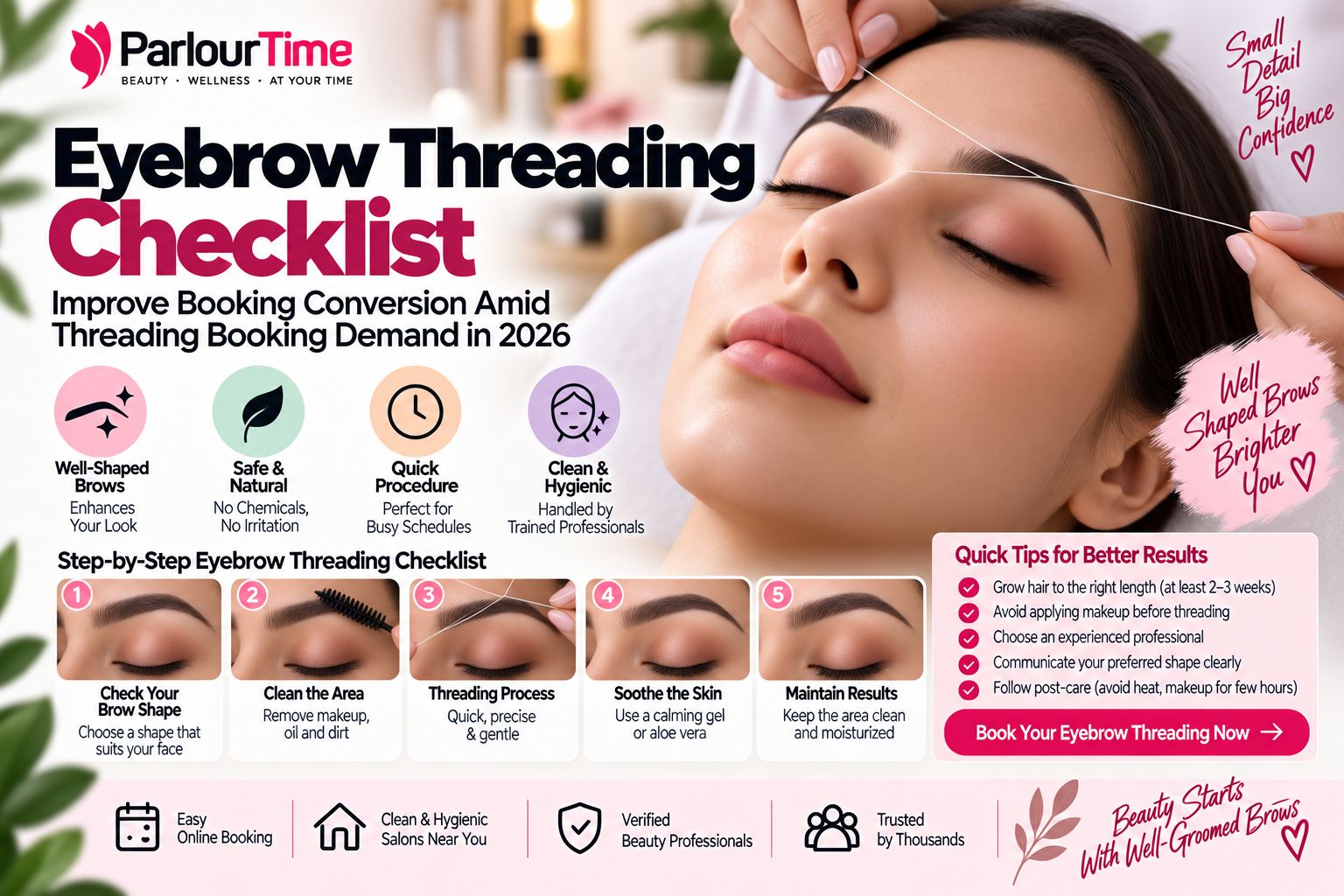


Eyebrow threading booking conversion breaks down when a confirmed slot is treated as a loose window instead of a promise. The fix is operational, not cosmetic: protect confirmed appointments, control how walk-ins enter the day, and measure whether enquiries actually end up seated. This eyebrow threading booking checklist is written for salon owners and front-desk teams who want fewer late finishes and steadier repeat visits. It is also for customers trying to understand why a threading slot sometimes does not hold.
Why Threading Bookings Drift During Peak Demand
The gap between what a client books and what they receive usually starts at the front desk. A slot is confirmed, a walk-in arrives, and staff assume the threader can finish the current client quickly. Once that habit takes hold, booked clients wait while unbooked clients are absorbed into the same hour. Rushing precision brow work shows on the face, and the client notices before anyone says a word. The confusion is rarely about skill. It is about whether the booking was treated as a commitment or as a hopeful note on a register. Two things drive most of the drift, and both are measurable: slot length that does not match real session time, and walk-ins accepted between fixed appointments.
Cut Drift With One Point Of Control: The Walk-In Gate
Pick a single decision point and hold it: the walk-in gate. This is the moment staff decide whether an unbooked client is seated now or offered the next open slot. Most salons skip this decision and let whoever is standing at the counter take priority. That single shortcut is the main reason confirmed bookings slide.
Define your gate in advance. Decide how many walk-ins can sit in any rolling hour, and decide who has the authority to break that limit. A common floor rule is one walk-in at a time, with a hard pause once confirmed bookings are visibly behind. Write the rule on the counter and make sure every shift knows it, because a gate that only one person enforces is not a gate.
The same control applies at booking. When a client calls, capture four things before assigning a slot: the service requested, shape correction or maintenance only, the last session date, and any event or facial planned nearby. This is your threading appointment checklist in four short lines. It takes seconds and prevents the surprise add-ons that stretch a short slot into a long one.
Build The Checklist Around Measurable Steps
Each step below carries one thing to watch. If you cannot measure it, you cannot tell whether the change worked.
Set the slot from the service, then measure: compare booked duration against actual seated-to-finished time for the same service type over a normal week.
Run a short shape consultation before threading begins, then measure: how often a client returns within a week asking for a correction.
Log the four intake answers at booking, then measure: how often a client adds a service at the counter that was not discussed on the call.
Apply the walk-in gate on every shift, then measure: how many confirmed appointments start later than their booked time.
Place complex sessions where they do not block a full run of simple ones, then measure: whether lateness clusters at specific hours of the day.
Send a confirmation the day before, then measure: no-shows and same-day cancellations by client, not just by week.
Ask about facials, cleanups, or exfoliation on the same day, then measure: any client reports of irritation and whether the same-day service was noted at booking.
Keep one person responsible for the running order, then measure: whether late finishes fall on days with more than one decision-maker at the desk.
None of these steps require new software. They require someone to look at the numbers once a week and adjust the gate, the slot length, or the staffing before the next busy stretch.
Decisions That Protect Conversion Without Burning Out Your Threaders
A threader working back-to-back clients for hours will slow down, and the last bookings of a session tend to absorb that slowdown. Protecting the tail of the day is a conversion decision, not a comfort one. If the same client keeps getting results they dislike from the same threader, treat it as a communication gap about the desired shape first, not a skill problem, and try a short consultation or a different pair of hands before anything else.
Pause walk-ins once confirmed bookings are visibly behind. Protecting existing appointments usually serves both the booked client and the walk-in better than stacking more people onto one threader. Booking threading a day or two before an event leaves room for any temporary redness to settle; booking it the same morning as a facial or cleanup is a timing risk worth flagging at the desk.
When several clients report the same issue, such as patchy shaping or rushed finishes, look at the schedule before you look at the technique. Some owners use parlourtime to review how booking timing lines up with service satisfaction before changing their slots. Broader questions about appointments and aftercare are covered in the parlourtime salon FAQs, and if you want your team trained for high-demand weeks, parlourtime courses are the structured route. The aim is not to fill more slots. It is to make sure each person who books actually gets the threading experience they came for.
What To Check In Your Busiest Threading Week
Late finishes lead the list: pull last week's start and finish times for confirmed slots and see where the delay sits.
Uneven shape complaints: confirm whether a shape consultation happened before threading started.
Redness or bumps after a session: check whether a facial, cleanup, or exfoliation occurred the same day and whether it was recorded.
Threader fatigue by evening: compare the number of clients per threader against the demand spike, not against last month.
Repeat no-shows from the same clients: check whether a confirmation went out before the appointment.
Walk-ins breaking confirmed slots: review how often the gate was applied and who was on the desk.
Declining repeat visits: read the last few complaint notes before assuming price or location is the cause.
Written by: Parlour Time Editorial Desk
Published: 23 September 2026, 10:21 PM IST | Updated: 23 September 2026, 10:21 PM IST
Powered by: Parlour Time