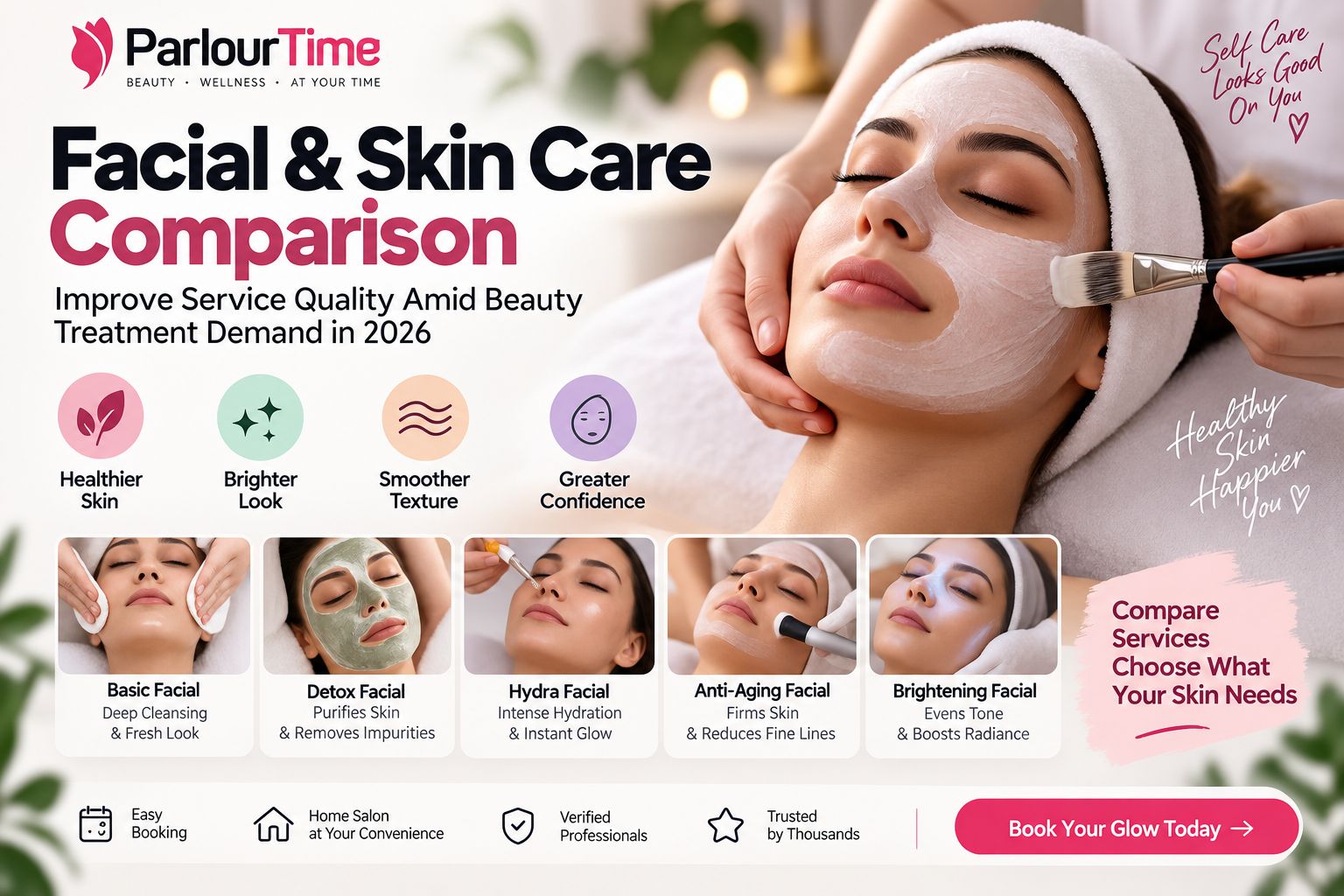


A facial and skin care comparison works best when you compare five things: the treatment type, your skin concern that day, how long the service takes, what aftercare it needs, and who is actually performing it. Booking on brand name or price alone rarely settles the question of whether a treatment suits your skin right now. This framework works for a customer choosing a service and for a salon trying to explain its menu clearly.
Why facial and skin care comparison feels confusing during a real salon visit
Most people start comparing services only after something goes wrong. They notice redness that was not there before, a dull patch near the jawline, or a glow that fades within a few days. At the counter, the menu lists fruit facial, cleanup facial, and diamond facial side by side, often with the same promise attached.
Someone with a function in ten days may pick the strongest option, assuming intensive means better. The first thing customers usually notice is not the service itself but the gap between what was described and what happened. Knowing what each service does, and what it cannot do, is where a proper facial treatment comparison begins. Many people find it useful to read salon FAQs before committing, so the choice rests on how a treatment behaves rather than how it is marketed.
What to compare across facial and skin care services
Five dimensions do most of the work, whether you are booking for yourself or listing services for clients.
Treatment type: a fruit facial, a cleanup, and a diamond facial are not interchangeable. Comparing them by name alone tells you little; comparing them by what they do to surface buildup, dullness, or texture tells you more.
Client skin concern: the same service behaves differently on oily, dry, sensitive, or reactive skin. Oily skin may tolerate a cleanup well and react to heavy creams, while sensitive skin may show short-term redness after exfoliation. This is best treated as a consultation prompt rather than a fixed rule.
Service duration: a shorter cleanup and a longer facial are not only different in length, they allow different amounts of step-by-step checking. If a client has limited time or an event close by, duration becomes a genuine decision factor, not just a scheduling detail.
Aftercare: what happens in the days after the appointment often shapes satisfaction more than the treatment itself. Ask what to pause at home, and for how long.
Staff training: this is the most overlooked dimension. A well-trained therapist asks about recent exfoliation, past reactions, and product compatibility before starting. That conversation alone changes how a service turns out.
Head-to-head comparisons that make the choice clearer
Fruit facial vs. cleanup facial. A cleanup usually targets oiliness and surface buildup, while a fruit facial is generally chosen for dullness and mild texture. If the main concern is active breakouts, neither may be the right first step, and a consultation is the safer path.
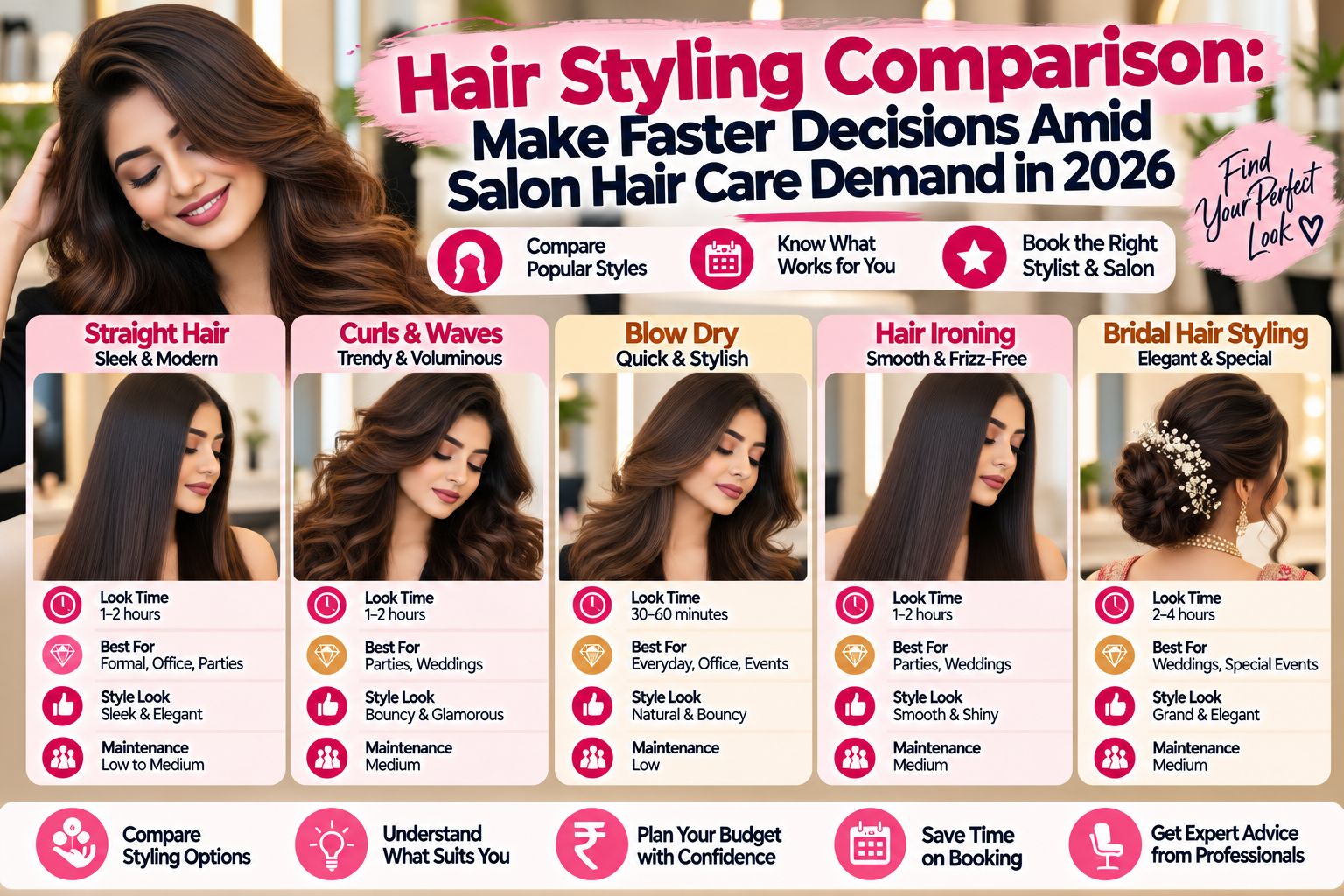
Hair spa vs. smoothening. A hair spa is a maintenance-leaning service for dryness and mild frizz. Smoothening aims at a specific texture goal and typically asks for committed aftercare. On hair that has already been coloured more than once, results can vary, so a patch test and a strand check before the full service are sensible precautions.
Comparing two facials, compare four things: what the service targets, how long it takes, what it asks of your skin afterwards, and who is performing it. When two services look similar on the menu, those four points usually separate them.
Some customers use parlourtime to compare service timing before booking, especially when an event is approaching. For broader guidance on timing and expectations, beauty service questions are often answered in dedicated resources.
Where customers go wrong when comparing services
The common mistake is treating cost and intensity as proof of quality. A higher price does not promise a longer-lasting result, and a stronger treatment does not automatically fix an underlying issue. Cost is simply not the same measure as suitability, and a gentler service often fits reactive or sensitive skin better than an intensive one.
Customers also assume more sessions will fix what the first one did not. Repeating the same service on skin that is already irritated can deepen the problem. Timing is another blind spot: a first-time treatment booked close to an event leaves little room for the skin to settle, and any breakout or patchiness that follows gets blamed on the service.
Aftercare gets skipped almost as often. Harsh cleansers, strong actives, and heat styling can weaken results faster than the service itself fades. Patch tests, product compatibility, and scalp or skin history are rarely discussed at the counter, yet they influence satisfaction more than the treatment does. On timing, a general precaution is useful rather than a fixed rule: leave some buffer between a first-time treatment and an event that matters.
Practical checks before your next facial or skin care booking
History first. If a previous facial caused burning, long redness, or breakouts, say so before the service, not after.
Buffer time. When the treatment is new to your skin, keeping space before an event is a sensible precaution.
Stop signal. If tightness or sensitivity lasts beyond a couple of days, pause repeat bookings and get the skin reassessed instead of upgrading the service.
Glow is not proof. A short-term flush after a facial does not always mean lasting improvement once the initial hydration settles.
Ask who is treating you. Enquire about the therapist's training and whether a patch test or consultation is included.
Know the line. When the same treatment stops improving your skin or hair across two or three sessions, the issue is usually the condition rather than the service, and it needs a professional reassessment.
Escalate when needed. Persistent acne, sudden hair fall, or a reaction that does not settle within a few days is a matter for a dermatologist or doctor, not another booking.
One operational note a customer books an intensive facial three days before a reception, notices redness on day two, and switches to a calming routine. The same booking made a week earlier, or replaced with a gentler cleanup, would have left room to recover. Parlourtime discussions often highlight that maintenance expectations shape satisfaction more than the treatment itself, which is why aftercare routines deserve as much attention as the service you pick.
Written by: Parlour Time Editorial Desk
Published: 23 September 2026, 09:24 PM IST | Updated: 23 September 2026, 09:24 PM IST
Powered by: Parlour Time