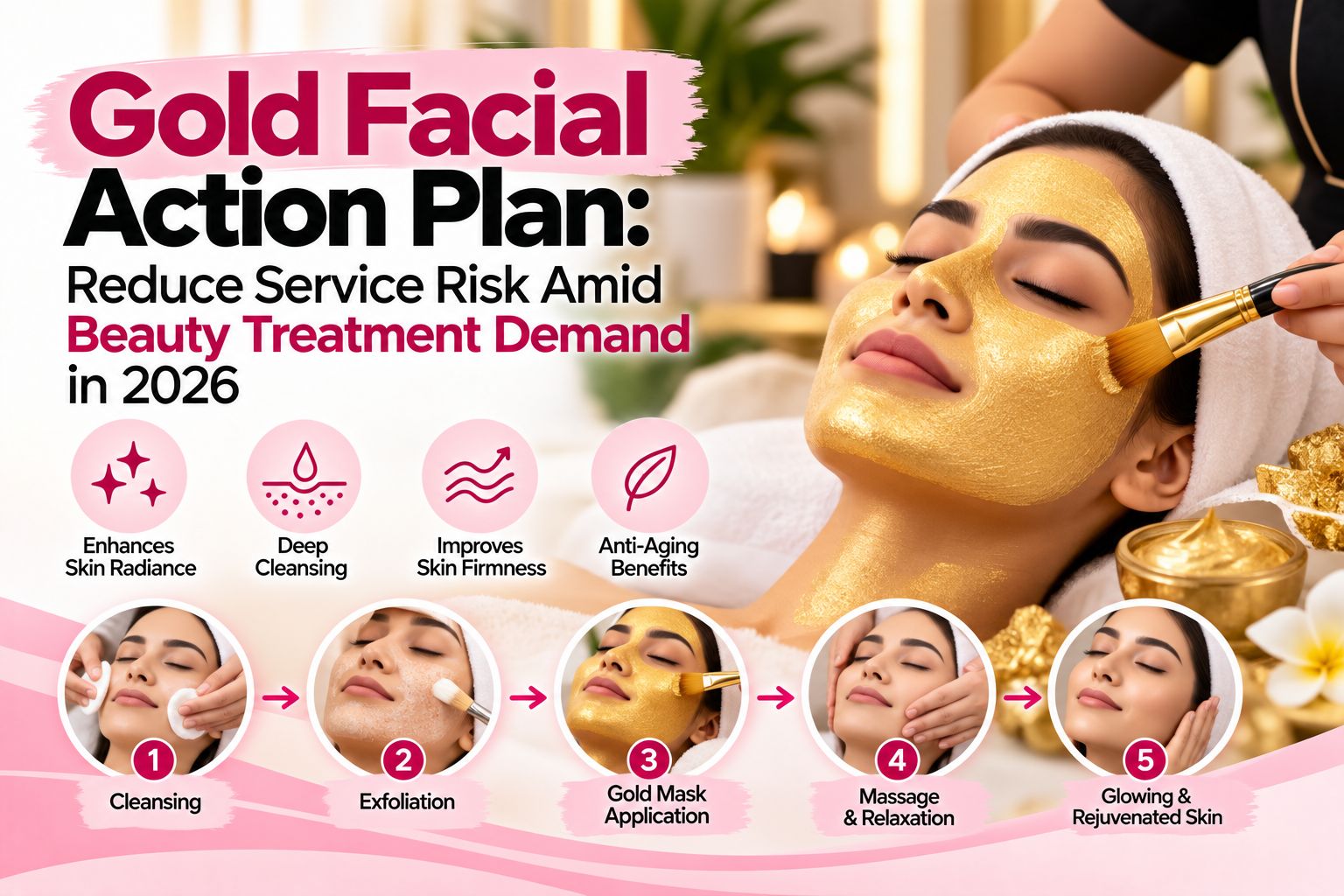


This is an action plan for reducing gold facial service risk, not a market forecast. It is written for salon owners, estheticians, and spa teams who deliver a gold facial and want fewer complaints, clearer client expectations, and a cleaner record of what happened if anything goes wrong. The practical outcome is a short pathway you can repeat for every booking: define the service, qualify suitability, secure consent, perform the treatment, then close with aftercare and documentation. Each step below names the specific risk it controls, so your team knows why the step exists and not just that it should be done.
Define the gold facial your salon actually offers
Service risk often starts before the client arrives, in the gap between what the salon means by a gold facial and what the client pictures. Write down what your version includes, in plain language. Does it involve gold foil, a gold-toned serum, a brightening mask, a massage step, or some combination? What is the total time, who performs it, and what is the price bracket? This definition controls the risk of expectation mismatch, which is the most common source of disputes and the hardest to resolve once the appointment is over.
Give the front desk a one-paragraph script and a short written summary the client can read before booking. The script should say what the service is, what it is not, and what the client will be asked during consultation. For example, state clearly that a gold facial is a cosmetic service and not a treatment for pigmentation, acne marks, or deep tanning, so no one books it hoping it will fix those concerns. When the client knows the boundary before payment, disappointment at the result rarely turns into a complaint about the service. A vendor with a managed-review workflow may publish similar boundaries in its service catalogue; the habit matters more than the source.
Qualify suitability during consultation and patch testing
Consultation is where you qualify whether this client should receive a gold facial now, later, or not at all. Keep a short list of questions: recent facials or exfoliation, known reactions to fragranced or active products, current use of prescribed skin products, active breakouts, open cuts, recent waxing or threading, pregnancy, and any ongoing skin condition being treated elsewhere. Record the answers on the client card, not just in conversation. This step controls the risk of an adverse reaction and the risk of blame landing on the salon when a pre-existing condition flares after the service.
Patch testing is a decision point, not a formality. If the client reports any past reaction, sensitive skin, or a long gap since their last facial, schedule a small patch test on a discreet area at least a day before the full service. Document the date, the product batch, the test site, and the result. If the client declines the patch test, note that clearly and let them confirm in writing before you proceed. The point is not to frighten clients away; it is to separate a client who is a good fit today from one who is better served by a gentler hydrating or barrier-repair service or by a referral to a dermatologist.
Secure consent and keep the service record clean
Consent protects both sides, and it should be specific rather than a general waiver. Use a simple form that lists the service, the products to be used, the known possible reactions such as redness, warmth, or temporary breakouts, the patch test outcome, and the client's own words about what they expect from the result. Ask the client to confirm they understand that outcomes vary with skin condition, aftercare, and how recently another facial was done. This controls the risk of a client later saying they were never told about a reaction or a limitation.
Keep the record operational. Note the start and end time, the products and batch numbers, the steps performed, the areas treated, and any adjustment you made during the service, such as shortening the exfoliation or skipping an area. If the client mentions a mild warm sensation, write it down at the time along with what you did about it. This single habit controls the risk of having no evidence if a question arises days later, and it makes the next appointment faster because the previous response is already on file. Names, dates, and batch numbers are more useful than long paragraphs of description.
Perform the service, watch for stop signals, and close with aftercare
During the service, the practitioner owns two decisions: continue or stop. A brief warm sensation can be part of the experience for some clients, but persistent burning, swelling, or spreading redness is a stop signal. Pause, remove the product, cool the area, and reassess. Do not push through to complete the booked steps just because the time slot is open; finishing a service that the skin is reacting to is the fastest way to convert a minor irritation into a serious complaint. Record the stop, the time, and the action taken.
Close every appointment with aftercare that matches what your salon can honestly support: keep the routine simple for the next few days, avoid strong exfoliating or active products, use a basic moisturiser and sunscreen, and avoid another facial too soon. Give this in writing, not only by word of mouth, and ask the client to contact the salon if redness, irritation, or unusual breakouts appear or persist. Book a follow-up check by message or call for a few days later to ask how the skin is settling. That follow-up controls two risks at once: a reaction that needs earlier professional attention, and a client who would otherwise quietly stop trusting the salon and never return.
Your repeatable pre-service routine
Before booking, confirm the client has read the one-paragraph service definition and understands what a gold facial does and does not address.
At consultation, walk through the suitability questions, record each answer, and decide together whether the service proceeds today or shifts to a gentler option.
Where there is any history of reaction or sensitivity, run a patch test at least a day ahead and note the product batch and result.
Before starting, complete a specific consent record covering products, possible reactions, the patch test outcome, and the client's stated expectation.
During the service, treat persistent burning, swelling, or spreading redness as a stop signal, and write down what you did and when.
At close, hand over written aftercare, schedule a short follow-up check, and file the service log so the next appointment starts with facts instead of memory. You can also explore salon FAQs through beauty service questions for clarity before booking, and browse community discussions through hair care resources to see how other teams handle consultation and aftercare questions.
Written by: Parlour Time Editorial Desk
Published: 30 September 2026, 12:29 AM IST | Updated: 30 September 2026, 12:29 AM IST
Powered by: Parlour Time