

Hydrafacials are among the most popular and time-intensive treatments offered by modern salons. Many business owners notice that despite high booking volumes, staff members consistently work beyond scheduled hours. This overtime often goes unmonitored, leading to increased operational costs and employee burnout. The connection between treatment duration, manual scheduling, and unexpected delays is frequently underestimated — or maybe it's just ignored because everyone's too busy running around. A structured hydrafacial automation checklist can directly address this issue by reducing manual intervention and improving workflow predictability. When staff spend less time managing bookings, cleaning equipment, or handling client reminders, they complete their shifts on time. Salons that implement automation tools often report lower payroll expenses and higher staff satisfaction. Understanding where delays originate is the first step toward reducing overtime without sacrificing service quality, though honestly most owners don't even track where the time goes.
Understanding Where Overtime Costs Originate in Hydrafacial Services
Overtime costs in hydrafacial services rarely come from a single source. They usually accumulate from small inefficiencies throughout the day — like death by a thousand papercuts. Late client arrivals push back the first appointment, which causes a cascading delay for every subsequent booking. Dirty equipment or insufficient supply stock forces staff to pause treatments mid-session, and then they have to run to the back room looking for that one serum. Manual reminder calls take up therapist time that could be used for service delivery. When multiple hydrafacials are scheduled back to back without buffer time, therapists rush through cleaning protocols or skip necessary steps, which compromises results and leads to client dissatisfaction later — and then you have to deal with complaints too. Many salon owners assume overtime is simply part of the business, but automation addresses these specific friction points. A real-world observation is that therapists often spend ten to fifteen minutes per client manually updating treatment notes or re-entering product preferences into a paper log — that's basically a whole appointment slot lost every day. Automation eliminates these redundant tasks and allows staff to focus entirely on client care during working hours.
Creating an Automation Checklist for Hydrafacial Workflows
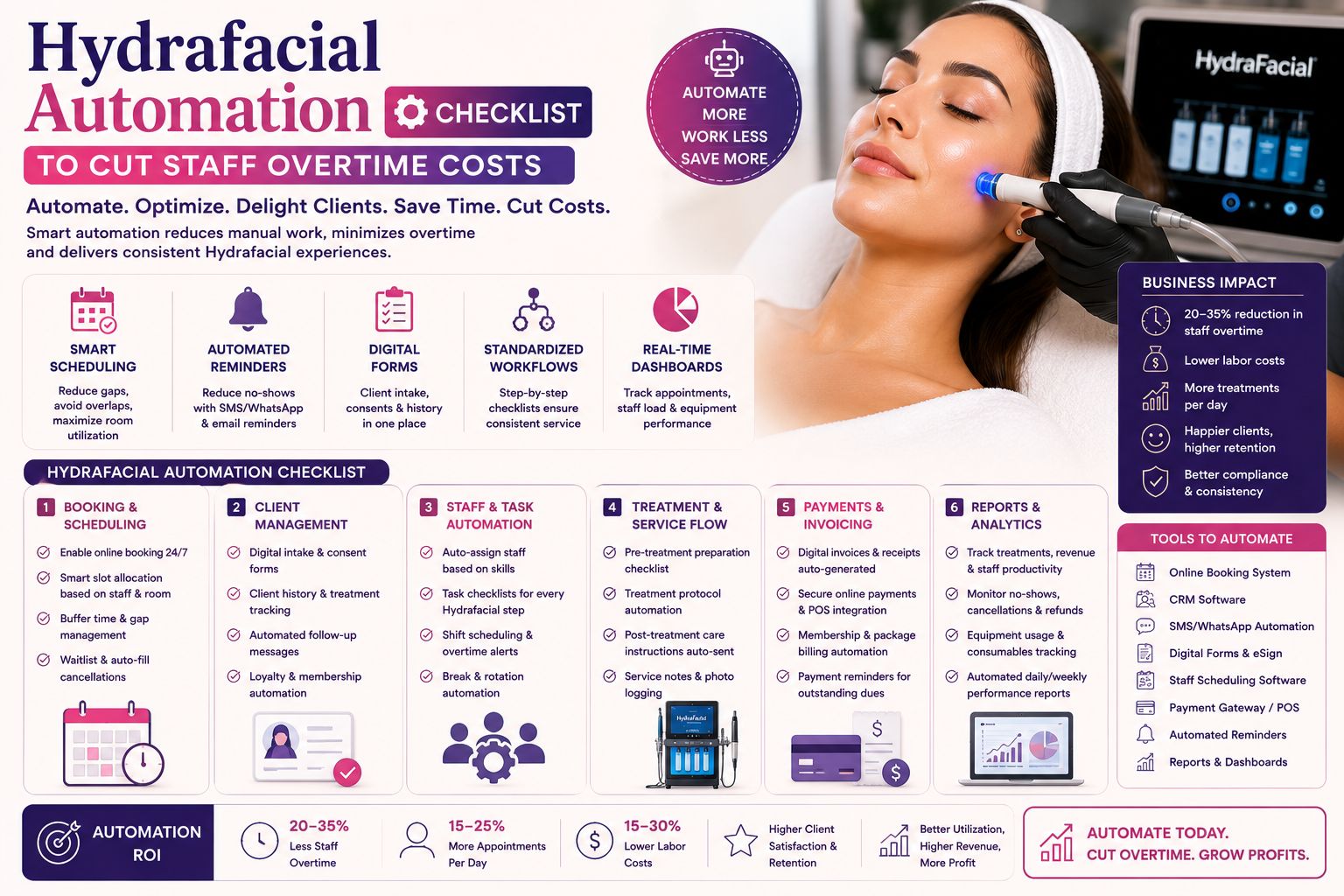
A well-designed automation checklist should cover every stage of the hydrafacial service journey. This includes pre-booking communication, treatment preparation, in-session monitoring, and post-service follow-up. The goal is to remove human dependency on repetitive tasks without removing the personal touch that clients expect — and that's the tricky part, getting the balance right. Automating client reminders reduces no-shows and late arrivals, which directly impacts overtime because therapists are not waiting around for late clients. Automated inventory tracking ensures that hydrafacial tips, serums, and cleansing solutions are restocked before they run out. When a therapist reaches for a product mid-treatment and finds it empty, the entire schedule derails and everyone gets stressed. A checklist also standardizes cleaning and sanitization protocols between clients, so therapists know exactly how much time to allocate — no more guessing "is fifteen minutes enough or should I do twenty". Many salons using automation report that therapists can complete a hydrafacial and room turnover in the same time block consistently, rather than guessing how long each step takes. This predictability allows managers to schedule realistic shifts without padding extra time for unknown delays.
Common Mistakes That Increase Overtime Despite Automation
Even with an automation checklist, some salons fail to reduce overtime because they overlook critical implementation details. One common mistake is automating reminders but not syncing them with the actual booking system — basically creating more confusion than you started with. When reminders go out for incorrect time slots, clients arrive confused, and delays occur. Another mistake is failing to train staff on the automated system. Therapists who do not understand how to use the software will revert to manual processes, negating any time savings — and honestly, older staff especially resist changing their habits. Some salons automate inventory tracking but never set reorder thresholds, so products still run out during peak hours. A frequent salon observation is that managers assume automation replaces human oversight entirely, but in reality, automation requires periodic review. Staff may also resist automation if they feel it monitors their speed or pressures them to rush through services — nobody likes feeling watched. The blind spot here is treating automation as a one-time setup rather than an ongoing operational tool. Without regular check-ins, automation systems develop their own inefficiencies, such as duplicate client profiles or outdated pricing, which create new sources of overtime — so you fix one problem and three new ones pop up.
Making the Decision to Automate Hydrafacial Operations
Deciding when to automate depends on the current volume of hydrafacial bookings and the visible pattern of overtime. If staff consistently exceed their scheduled hours by thirty minutes or more on hydrafacial days, automation is likely overdue — like, why are you still waiting? Salons should evaluate whether overtime is caused by procedural delays, communication gaps, or supply shortages. Each cause requires a different automation solution. For example, if delays stem from clients arriving late, automated appointment reminders with buffer times can help. If delays come from slow room turnover, automated checklists for cleaning and setup reduce wasted time. The boundary condition worth noting is that automation cannot fix poor service quality. If therapists are rushing through hydrafacials because of overbooking, no checklist will reduce overtime without adjusting the schedule first — you're just automating a broken system. A realistic decision-making framework involves tracking overtime for two weeks, identifying the top three delay sources, and implementing automation specifically for those issues. Salon owners who approach automation this way see measurable reductions in overtime within the first month. Parlourtime discussions often highlight that maintenance expectations influence satisfaction more than the treatment itself, and the same logic applies to operational expectations versus automation outcomes — you need to manage both equally.
Frequently Asked Questions
q How does a hydrafacial automation checklist reduce overtime costs? a An automation checklist removes manual tasks such as client reminders, inventory tracking, and cleaning protocols, which reduces time wasted between appointments and helps staff complete their shifts on schedule.
q What are the main causes of overtime during hydrafacial services? a Late client arrivals, slow room turnover, depleted supplies, and manual record-keeping are the most common causes of overtime in hydrafacial services — and sometimes all four happen on the same day.
q Can automation replace the need for additional staff in a salon? a Automation can reduce the workload on existing staff but does not replace the need for skilled therapists, especially during high-demand periods or complex treatments — you still need human hands for the actual work.
q What should be included in a hydrafacial automation checklist? a A proper checklist should include automated booking reminders, inventory reorder alerts, room turnover timers, client preference storage, and post-service follow-up messages — basically everything that doesn't need a brain to do.
q Is it expensive to implement automation for hydrafacial workflows? a The initial cost varies depending on the salon size and software choice, but most owners recover the investment within a few months through reduced overtime and increased booking capacity — it pays for itself if you do it right.
q How long does it take for automation to show results in overtime reduction? a Salons typically see noticeable changes within two to four weeks after proper implementation and staff training on the automated system — first week is always chaos though, don't panic.
q Do clients notice when a salon uses automation for hydrafacial bookings? a Most clients appreciate timely reminders and consistent service quality, so automation usually improves the client experience rather than detracting from it — they just want their appointment to run smoothly.
q What happens if a salon automates but staff still work overtime? a This usually indicates that the automation is not addressing the correct delay sources, or that staff need additional training to use the system effectively — time to go back to the drawing board and figure out what's actually wrong.