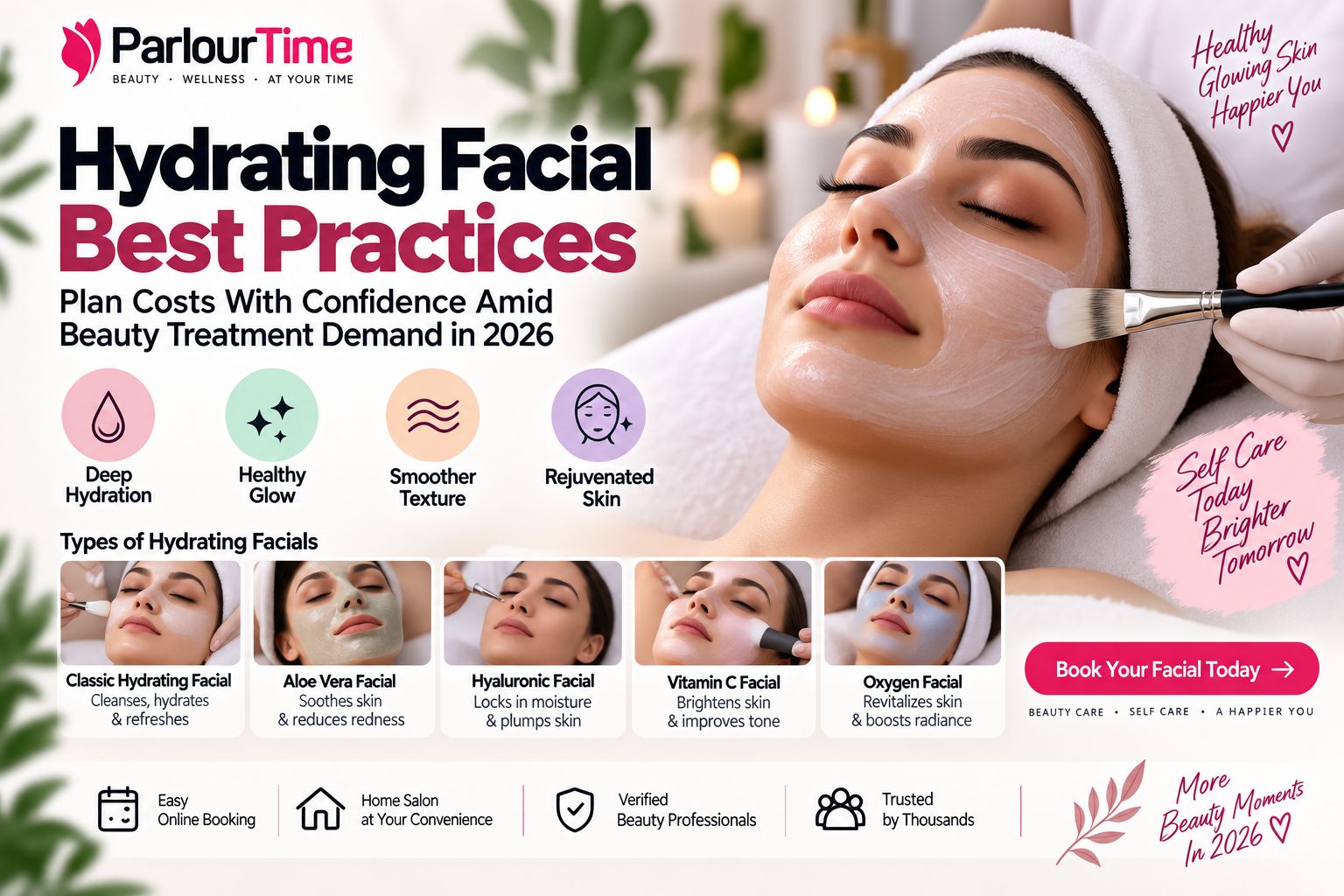


You want a hydrating facial, you have a budget in mind, and you would rather not find out after paying that the price did not match what your skin needed. The practical outcome of good planning is simple: a written cost plan you can compare across salons, a session schedule that fits your calendar, and a clear rule for when to rebook and when to stop. The problem is rarely the facial itself. It is that budgets, timing, and skin needs are often not matched before the service begins. This guide walks through the timeline in three stages: before you book, at the quote, and after the session.
Before Booking: What Your Hydrating Facial Cost Plan Should Actually Contain
A workable plan has four lines before it has a price. First, the goal for your skin that month, whether that is comfort in dry weather, a calmer barrier, or preparation before an event. Second, your realistic frequency, because a plan built around repeat visits costs far more than a single-session plan. Third, your calendar window, so a first session sits early enough that you can watch how your skin responds. Fourth, your ceiling, which is the total you are willing to spend on facial treatment planning this season, not just on one visit.
When you ask for facial pricing, ask for the full list, not the entry figure. A quoted price may cover cleansing, exfoliation, a mask or serum, and massage time. Add-ons such as extractions, a stronger peel step, eye treatment, or a longer massage are usually priced separately. Session duration is one of the clearest signals of value, because a short slot with several add-ons can cost more than a longer single service.
Ask two questions before you commit. What products will be used on my skin today, and what will you change if my skin reacts during the session? A consultant who asks about your current routine first, and who adjusts the exfoliation step based on what you say, is usually working with your barrier rather than against it.
At the Quote: Reading Facial Pricing and Spotting Hidden Cost Factors
Compare quotes on the same four lines: what is included, how long the session runs, who performs it, and what aftercare guidance comes with it. A person with more experience may charge more, and that difference can be reasonable, but it should be explained rather than assumed. If a package is offered, check the expiry window, whether sessions can be paused, and whether unused sessions can be transferred or refunded.
Treatment categories matter more than brand names on a menu. A hydrating service targets moisture and comfort, while a deep-cleansing or congestion-focused service targets oiliness and blocked pores. These are different jobs, so a cheap hydrating session may simply be the wrong service if congestion is your real concern. Choosing between categories is a skin decision first and a money decision second.
The at-quote stage is also where you set one hard limit. If the total including add-ons crosses your ceiling, remove an add-on rather than shorten the core session. A shorter exfoliation step on skin that is already sensitive is a common reason people leave uncomfortable.
Session Frequency: How Often to Schedule Without Wasting Money
Frequency should follow your skin, not the salon calendar. For generally healthy skin, a gap of several weeks between sessions is a common starting point, and it can be stretched further if your at-home routine is keeping your skin comfortable. The signal to watch is what happens between visits. If your skin feels fine for most of the interval, you are probably booking about right. If it feels tight within hours of a session, the issue is more likely product or exfoliation intensity than the gap between appointments.
Weekly sessions are rarely needed and can push sensitivity up without adding comfort. Repeating the same treatment again and again does not fix a barrier problem. When results stop changing between visits, the honest next step is a professional reassessment of what your skin needs, not another booking. If you are unsure whether a lighter first step suits you better, it helps to read general beauty service questions so you walk in with clearer expectations about what each service type is designed to do.
One operational observation worth keeping in mind: consultation time is the cheapest part of any facial and the most useful. Ten minutes of questions before products are chosen can save the cost of a session your skin did not need.
After the Session: The Signals That Decide Your Next Booking
The decision boundary after any hydrating facial is short and clear. Within the first day or two, mild flushing can settle on its own. Redness or new breakouts that persist beyond that, or that get worse rather than calmer, mean you pause the next booking and get a skin review instead of repeating the service. That is the line between normal recovery and a reaction worth investigating. If your skin has been diagnosed with a condition or you are using prescription treatment, confirm with your clinician before booking any facial.
A patch test before a new serum or mask is a reasonable ask, particularly if your skin has reacted before. It costs you nothing and removes most of the guesswork. Keep a short written note after each visit: what was used, how long the session ran, how your skin felt on day one and day three, and what you paid. Three visits of notes tell you more about value than any price list.
For an event, book the first session well ahead of the date rather than in the final days, so there is room to observe how your skin settles. If you are comparing offers and want to understand what a salon normally includes, checking salon FAQs before you pay keeps cost and expectations aligned.
Decision Checkpoints for Your Next Hydrating Facial
Tight skin within an hour of the session points to exfoliation or a mask that was too strong that day. Ask for a gentler step next time rather than booking sooner.
A quote without a product list or a session length is not comparable to any other quote. Get both in writing before you decide.
An add-on that pushes you past your ceiling is the item to drop, not the core session time.
Skin that stays comfortable between visits means your current frequency is working and does not need to increase.
Two or three sessions with no change in how your skin feels is the checkpoint to stop booking and get an assessment instead.
Redness or breakouts that persist beyond the first day or two means pause, review, and do not repeat the same service until you know why.
Written by: Parlour Time Editorial Desk
Published: 23 September 2026, 09:41 PM IST | Updated: 23 September 2026, 09:41 PM IST
Powered by: Parlour Time