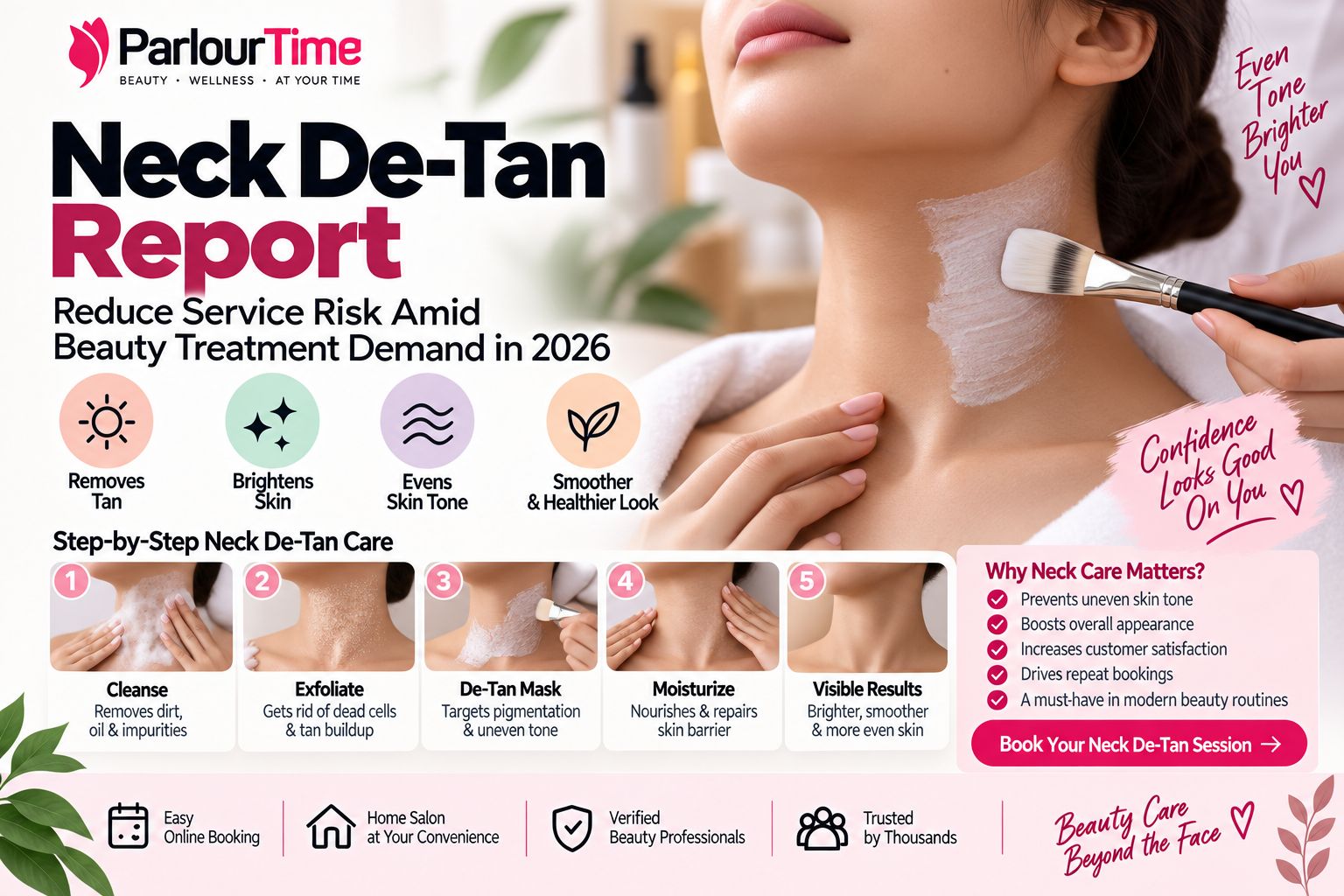


Neck de-tan is an easy service to sell and a hard one to control. The treatment area sits close to the face, clients compare both zones in the mirror, and results often depend on habits that started long before the appointment. For salon owners and service providers, the practical outcome is simple: a repeatable way to decide who is safe to treat, when to slow down, and when to stop and refer. That is what this guide covers.
Why neck de-tan carries more risk than it appears
The service looks low-risk because it covers a small area and takes little time. The complications come from elsewhere. Neck skin is comparatively thin, it folds and creases, and it is one of the most sun-exposed parts of the body for anyone who commutes daily. Consultations are usually rushed, patch testing is often skipped, and aftercare instructions are given verbally at the billing counter when the client is already leaving.
The result is a predictable pattern. A client returns days later saying the neck looks patchy, tight, or darker in places. Staff members rebook another session to fix it. The second session compounds the first, and the complaint grows instead of settling. Documenting a clear service protocol and sticking to it removes most of that cycle. A treatment that follows a defined path is far easier to defend and far easier to repeat safely.
Screening and patch testing before the first session
Most avoidable problems are decided at the consultation desk, not the treatment bed. A short intake routine gives the technician enough information to proceed, adjust, or decline.
Ask when the last de-tan, waxing, threading, or exfoliating service was performed on the neck, and note it in the client record. Ask about known reactions to previous salon products, current use of prescription creams, and any active irritation, rash, or broken skin. If the client has had a recent reaction or is using a strong topical product, do not proceed on the same day. Ask whether the neck has been exposed to sun, pool water, or heavy dust in the past week, because freshly exposed skin reacts differently from settled skin.
The patch test matters more than the consultation. Apply a small amount of the intended product behind the ear or on the inner forearm, leave it for the manufacturer's stated contact time, and rinse. Record the date, product, and outcome. If patch testing was done at a previous visit, confirm the product has not changed since. When the formula is new to the salon, patch test again rather than assuming the earlier clearance still applies.
A workable decision rule: if the client cannot answer basic questions, or if the skin shows any active irritation, reschedule rather than improvise. The lost booking costs less than a reaction.
Application boundaries and product selection
Standards slip most often when a technician is working fast. Two boundaries prevent the majority of complaints.
First, treat only intact skin. Any cut, rash, recent waxing, or freshly shaved area stays out of the service area. Second, keep the product inside the treatment zone and away from the jawline and hairline unless the protocol specifically allows it, because overlapping applications produce uneven tone.
Product selection should follow the client's skin behaviour, not the price tier of the package. A higher-priced add-on does not automatically deliver a better result, and staff should never imply that it will. If a client asks for a stronger option, explain that the formula is chosen for compatibility and that the strength is not the deciding factor. Where the client requests a combination of services on the same visit, space them rather than stacking them.
One operational observation from salon floors: technician consistency matters more than product choice. Two staff members applying the same product to the same client on different days can produce two different outcomes if their timing, coverage, and rinsing habits differ. Write the protocol down, keep it at the station, and follow it the same way every time. A vendor with a managed-review workflow usually approaches this by locking the steps into the service record; an independent salon can achieve much of the same control with a printed checklist and initials.
Aftercare script, documentation, and escalation triggers
Aftercare fails when it is spoken once and never recorded. Give the client a short printed or messaged script covering the next seven days, and note in the file that it was provided. Keep it to a few lines: cleanse gently, moisturise the area, avoid sun exposure, and pause other active products until the skin feels normal. Do not add brightening serums or facial night creams to the neck unless the formula is intended for that area.
Staff should also know which instructions to stop giving. If a client reports tightness or redness, the correct response is recovery time, not a product recommendation or an earlier rebooking. If the concern continues or worsens beyond the expected settling period, refer the client to a doctor or dermatologist rather than repeating the service. This is a boundary, not a sales opportunity.
Escalation works better with written triggers than with individual judgement. Agree on three levels in advance and record which one applied at each visit, so reviews at month end show where complaints actually originate.
Risk thresholds for continuing or stopping the service
Use these thresholds as decision rules at the consultation desk. They are operational steps for service delivery, not medical advice, and they replace the habit of deciding in the moment.
Low risk, proceed on schedule: skin is intact, no recent reaction, patch test clear, and the client can follow aftercare. Book the next session at the salon's standard interval and note the outcome.
Moderate risk, treat with caution: minor sensitivity, a recent exfoliating service, or a client who cannot confirm product history. Reduce contact time, narrow the treatment area, and confirm the patch test is current before starting.
Screening gap, reschedule: the client cannot answer intake questions, or the record is missing a patch test for the product in use. Do not proceed on assumption. Rebook once the information is complete.
Pause and recover: visible redness, tightness, or a reporting of stinging. Stop exfoliating and brightening products on the neck, provide the aftercare script, and set a review date instead of an immediate rebooking.
Stop and refer: the neck tone stops responding across correctly spaced sessions, or the concern persists and worsens. Refer to a qualified medical professional and log the referral in the client file.
Documentation rule across every level: record the product, contact time, area treated, patch-test status, aftercare given, and any escalation level applied. Without these fields, patterns stay invisible and complaints repeat.
One short internal note is enough to apply this consistently: the value of a neck de-tan service comes from repeat clients who trust the outcome, and that trust is built at the screening step, not the finishing step. For event bookings, place the session early enough in the client's calendar that recovery time exists if the skin needs it.
Written by: Parlour Time Editorial Desk
Published: 23 September 2026, 10:16 PM IST | Updated: 23 September 2026, 10:16 PM IST
Powered by: Parlour Time