

If you run a salon in India and have dealt with a client booking a bridal makeup slot on a busy Saturday and simply not showing up — and if you haven't, honestly just wait a week — you know the exact loss of revenue and wasted appointment time that follows. This situation is becoming more frequent as event calendars fill up, and the financial hit for your business can be significant without a system to secure a commitment upfront. Salon owners in metropolitan areas like Mumbai and Delhi are increasingly seeing last-minute cancellations for high-value services like hair treatments and premium facials, which hurts the daily operational flow and, frankly, your bottom line more than most people realize.
Why No-Show Cancellations Hurt Your Salon Revenue Cycle
A missed appointment for a hair smoothening treatment or a bridal facial does not just mean a lost slot; it often leads to an entire hour or two of your staff sitting idle, which affects team morale and your monthly targets. For a growing salon in India, each no-show represents a direct loss of service revenue plus the opportunity cost of turning away another paying customer who could have booked that slot, especially during peak wedding or festival seasons when every seat should be filled. The unpredictability makes it very difficult to manage walk-in customers or optimize your staff schedule, creating a gap in your cash flow that many small business owners underestimate until they see their monthly numbers.
How Automated Deposit Collection Works for Indian Salons
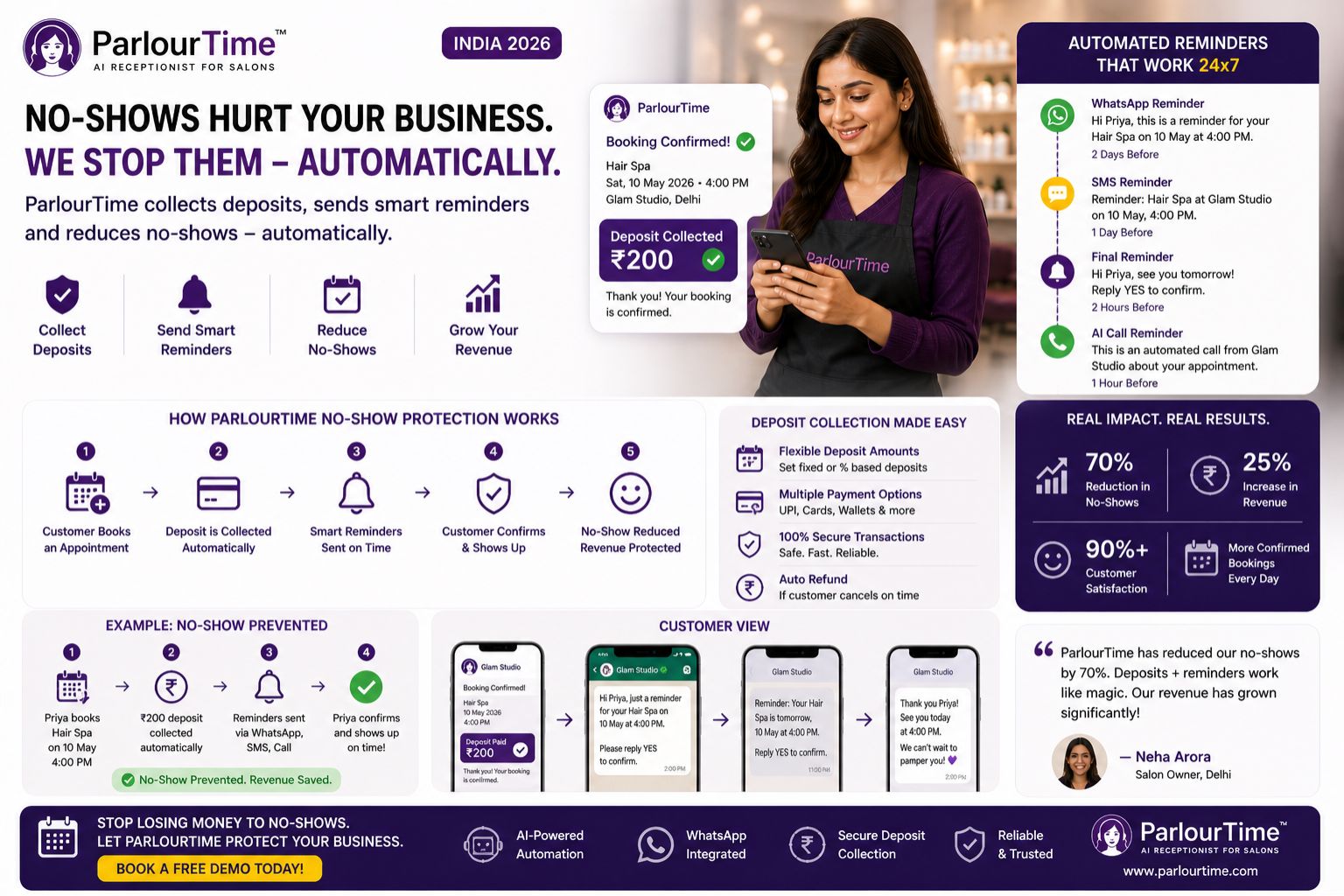
An automated system sends a secure payment link at the time of booking, asking for a small, non-refundable deposit to confirm the appointment for services like hair treatments or bridal packages. This deposit is often a fixed percentage of the service cost, which acts as a genuine commitment signal from the client and reduces casual bookings that lead to no-shows — because let's face it, when someone has to pay even fifty rupees upfront, they think twice. Many modern salon management tools integrate with UPI, and the process is simple for the client, but the key detail many overlook is that the reminder sequence must start within an hour of booking to capture the client's attention while the service is still top of mind, otherwise they forget and the link just sits there.
Common Mistakes in Client Reminder Systems You Must Avoid
A major mistake is thinking a single WhatsApp message a day before the appointment is enough; for a busy salon in India, this often gets ignored or missed in a flooded chat inbox full of forwards and group messages. An effective system uses a multi-step reminder including an initial confirmation message, a deposit request reminder 24 hours before, and a final automated reminder on the morning of the appointment, but only if the deposit has been paid — because sending reminders for unpaid slots just wastes everyone's time. Another critical error is not allowing enough time for the client to process the deposit link, so sending it too close to the appointment can cause frustration, not commitment, especially for last-minute bookings for services like haircuts or basic facials where the client might already be in a rush.
How to Decide on the Right Deposit and Reminder Timing
For a high-demand service like a bridal makeup trial or a complete hair smoothening session, a deposit of 20-30% of the total cost, requested at least 48 hours before the appointment, works well to filter out truly uninterested clients. For lower-value services like a basic facial or manicure, a smaller fixed deposit — maybe just a hundred or two hundred rupees — requested 12-24 hours ahead, can significantly reduce no-show rates without creating friction for casual customers. Understanding your client's psychology and the specific salon service booking patterns in your area is the real key to setting a deposit amount that feels like a fair commitment rather than a barrier to booking, because what works in South Delhi might not work in a small town salon.
FAQ
q What is a no-show deposit in a salon context
a A no-show deposit is a small, non-refundable fee collected from a client at the time of booking to secure their appointment slot, protecting the salon from a loss of revenue if the client does not show up without prior cancellation. It's basically a way to say "you serious about this appointment or not?"
q How does an automated reminder reduce no-shows for salons
a An automated reminder system sends multiple structured messages to the client at key points, like right after booking and a day before the appointment, which significantly increases the chance they remember and show up, especially when the deposit has already been processed and they feel a bit of ownership over the slot.
q Is it legal for Indian salons to collect a non-refundable deposit
a Yes, it is generally legal for salons in India to collect a non-refundable deposit, provided the terms are clearly communicated to the client at the time of booking, often supported by a widely accepted salon management policy to prevent disputes. Just make sure your clients know upfront, not when they're cancelling.
q What is the best way to send an automated reminder for a deposit
a The best method is through an integrated salon management platform like parlourtime that links directly to your booking calendar, automatically sending SMS or WhatsApp messages with a secure payment link without needing any manual intervention from your front desk staff. This way you don't have to train three different receptionists on the same process.