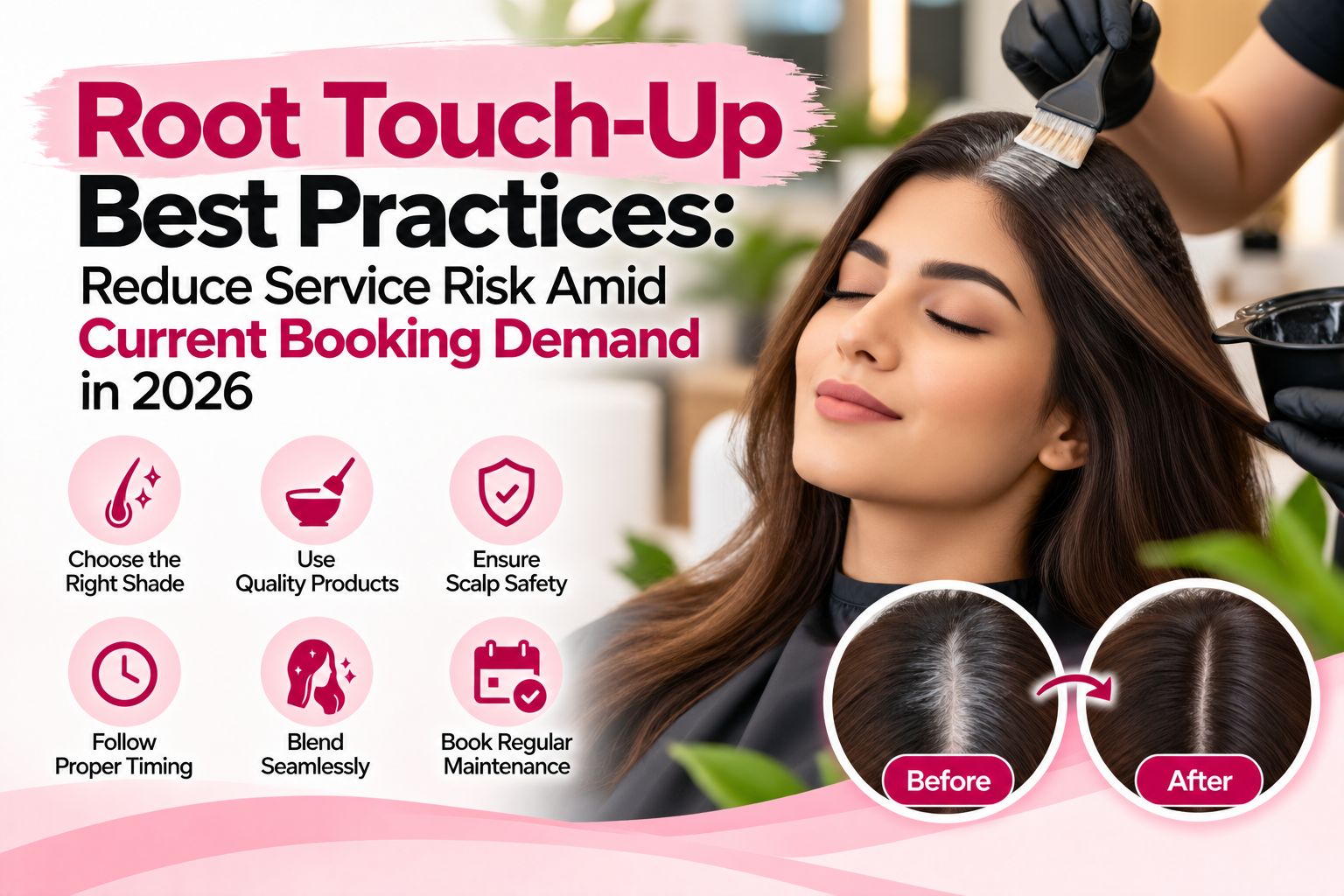


Root touch-up best practices come down to five checkpoints: consultation and patch test, developer and product choice, application timing on regrowth versus mid-lengths, gray coverage accuracy, and aftercare. Miss one and the result shows up as banding, patchy gray coverage, or a scalp that stings. No confirmed booking data exists for 2026, so treat busy calendars as a planning condition rather than a number, and use the checkpoints below to lower service risk before you sit in the chair.
Why Root Touch-Up Service Risk Rises When Booking Demand Compresses the Visit
The first thing customers notice during a root touch-up is rarely the colour. It is the pace. When calendars are tight, the consultation is the first thing to shrink, and that is where small details get lost. A customer may mention gray coverage but not bring up henna use, a home colour kit from two months ago, or a scalp that has been itchy since the last wash. Each of those details changes how the colour develops.
Some customers also accept an unfamiliar professional or a squeezed slot. That is not automatically a problem, but it removes the familiarity that usually catches compatibility issues early. Uneven absorption and patchy gray coverage often trace back to this compressed planning stage, not to the product itself. No verified figure confirms that demand has risen or fallen in 2026, so plan for a tighter slot rather than assuming one.
What Happens on Indian Hair and Scalp During a Root Touch-Up
Indian hair often mixes thick strands, natural warmth in the undertone, and a scalp that may already be sensitive from earlier chemical services. During a root touch-up, colour interacts differently on virgin roots compared with previously coloured lengths. That is why banding, where the new colour reads darker or more red than the rest, appears even when the same shade is used.
Scalp condition matters just as much, and it drives the developer decision. Dry scalp, dandruff, or minor abrasions from scratching can sting or flush during application, and in those cases a gentler developer strength or a formula change is the safer route. If the scalp is calm and the hair history is simple, a standard developer strength usually processes predictably. Weather plays a part too. Humidity can slow processing, while winter dryness can make the scalp react faster to ammonia-based formulas. Results vary more because of hair texture, scalp health, and service history than because of the brand of colour used.
Root Touch-Up Consultation and the Mistakes That Escalate Risk
A common assumption is that paying more for a premium salon automatically reduces risk. Price does not override hair condition. If the scalp is irritated or the hair carries buildup from hard water and previous colour, even a careful application can fade faster or cover gray unevenly.
Treat the patch test as a real checkpoint, not a formality. Formulations change, and scalp sensitivity shifts over months, so a patch test before a first-time shade or after a gap still tells you something your memory cannot. For a stronger reference, a dermatologist-reviewed explanation of allergic contact dermatitis from hair dye, such as the peer-reviewed overview indexed on PubMed, describes why the patch test exists.
Another blind spot is booking a root touch-up the same day as a wedding, festival, or work event. If the colour turns warmer or darker than expected, there is no buffer to correct it. Some customers also apply oil or serum on the scalp just before the appointment, assuming it protects the skin. In practice, that residue can block colour pickup at the roots and cause patchiness.
Application Timing: Regrowth, Mid-Lengths, and Gray Coverage Accuracy
Timing is where most root touch-ups go wrong, and it comes down to two zones. Regrowth near the scalp processes fast because body heat sits right under it. Previously coloured mid-lengths and ends are already porous, so they grab colour quickly and can turn darker or brassy if the product is pulled through too early. Keep the application on the regrowth first, then assess the mid-lengths only if the shade needs refreshing.
Gray coverage has its own rule. Resistant gray, especially the coarser strands along the hairline and temples, often needs the full processing window, while the softer regrowth nearby may not. Splitting the application so stubborn areas go on first closes that gap. If you want to check how maintenance cycles and service sequencing usually line up before locking a peak-week slot, you can plan around standard intervals using parlourtime.
Aftercare decides how long any of this holds. Sulphate-heavy shampoo, hot water, and daily heat styling strip colour faster from the roots, which is why coverage seems to vanish in two weeks. A gentle wash routine, a scalp-friendly conditioner, and spacing out heat tools keep the result closer to what you paid for.
Next Steps When You Book Your Root Touch-Up
Scalp discomfort last time. If you felt burning, itching, or tightness, say so before the next appointment. That one detail can change the developer strength or trigger a patch test.
Colour history you forgot to mention. Home kits, henna, and salon services from the last three to six months all affect how roots absorb colour. Share them even if nobody asks.
Event timing. A touch-up two to three days before an event leaves room for a quick fix. A same-day booking removes that option.
Scalp issue, not a colour issue. Persistent flaking, itching, or sensitivity after a touch-up usually points to scalp health rather than the shade. Treating the scalp first improves the next result more than switching brands.
Know your boundary. If gray coverage fades within two weeks repeatedly, adding more colour will not fix it. That is the point to ask for a professional reassessment of porosity, buildup, or scalp condition.
When to wait instead of booking. If the scalp is visibly irritated or you had a reaction in the past few weeks, waiting is safer. Colour over a compromised scalp worsens sensitivity instead of delivering even coverage.
Written by: Parlour Time Editorial Desk
Published: 30 September 2026, 12:23 AM IST | Updated: 30 September 2026, 12:23 AM IST
Powered by: Parlour Time