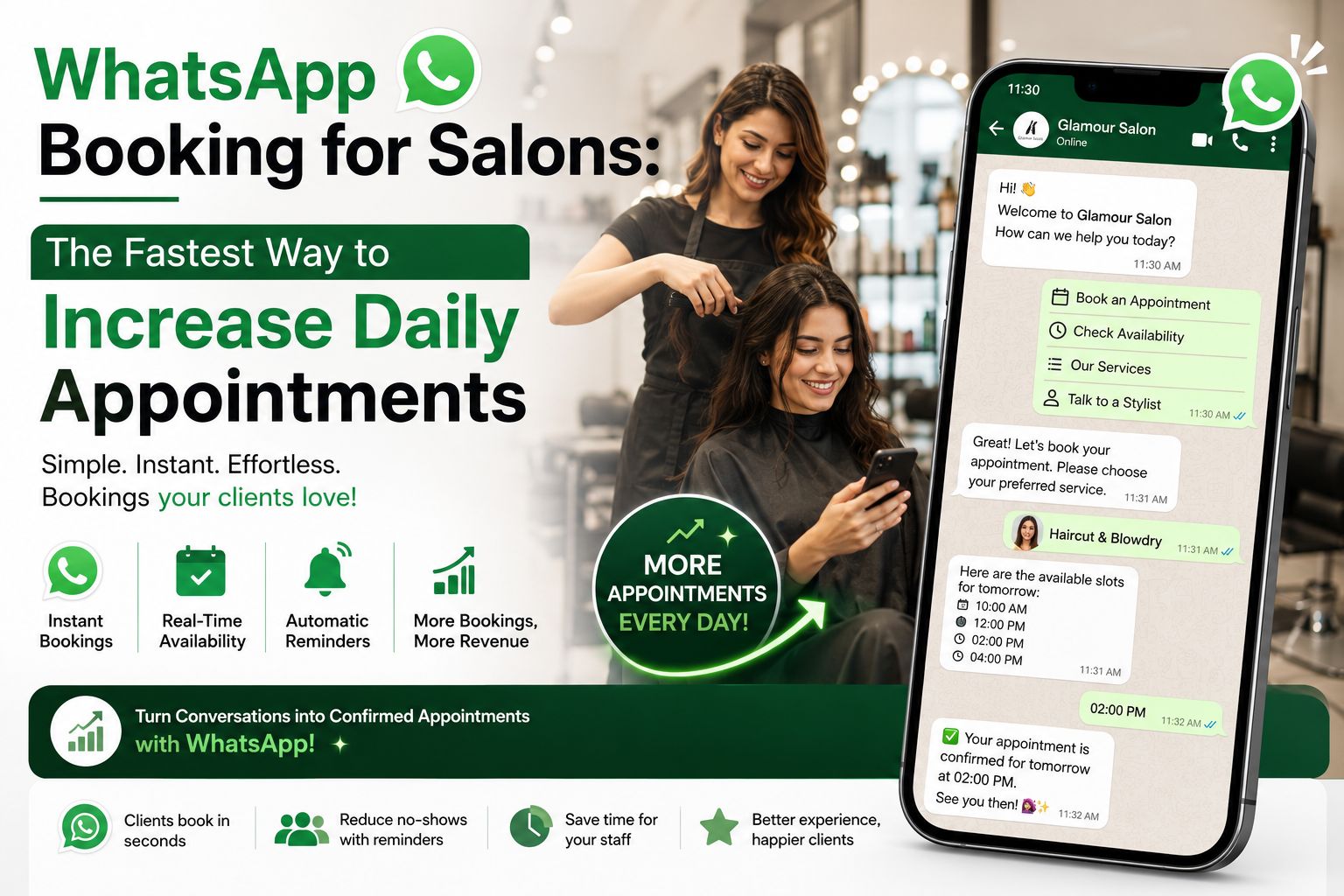


Salon owners often lose appointments because clients forget to confirm or calls go unanswered during busy hours. WhatsApp booking for salons has become the fastest way to increase daily appointments—honestly, it just reduces that friction between the client and the booking process. Many customers already use WhatsApp daily, so asking them to book through the same app feels natural, like... convenient without being pushy. The confusion happens when salon owners rely on fragmented systems—phone calls, text messages, and walk-ins—that create gaps in communication. A single missed call can mean a lost appointment for the entire day, I've seen it happen. Switching to a structured WhatsApp workflow removes this uncertainty and makes booking predictable again. The problem is not about whether clients want to book. It is about how easily they can do it without waiting for a response.
Why Relying on Phone Calls Creates Appointment Gaps
Phone calls seem reliable but they create hidden gaps in daily bookings. When a client calls during a haircut or facial service, the receptionist may miss the ring or put the client on hold. Many clients hang up after three rings and move to another salon—I've done that myself honestly. This is where WhatsApp booking for salons fills the gap. Clients can send a message anytime, even outside working hours, and receive an automated reply with available slots. The salon does not lose the lead. The client does not feel ignored. This system works especially well for treatments that require preparation, such as hair smoothening or bridal facials, where timing and availability matter most. Without a messaging fallback, both sides lose time and money. The gap is not about willingness. It is about availability of communication.
How WhatsApp Reduces No-Shows Without Manual Follow-Ups
No-shows happen because clients forget or double-book without updating the salon. Manual follow-ups take time and staff often skip them during peak hours—who has time when you're doing back-to-back facials, right? WhatsApp booking for salons solves this by sending automatic reminders one day before the appointment. The client receives a simple message with the service name, time, and salon address. They can confirm or reschedule with one reply. This small step dramatically reduces last-minute cancellations and empty chairs. The benefit extends beyond convenience. It builds accountability because the client feels connected to the booking. Salons that use this method report fewer gaps between services and higher daily revenue. The psychology is simple. When a client receives a professional reminder, they treat the appointment with more seriousness than a mental note or calendar alert they ignored.
The Risk of Using Personal Numbers for Business Bookings
Many small salon owners start by sharing their personal WhatsApp number with clients. This leads to confusion between personal messages and business inquiries. Clients message late at night, expect instant replies, and feel frustrated when the salon owner does not respond quickly—I've had this happen with my parlour. WhatsApp booking for salons works best when the business uses a dedicated number or a WhatsApp Business account with automated replies and quick reply templates. This separation protects the salon owner's personal time and sets clear boundaries for client communication. Without this structure, the owner burns out and the booking system becomes unreliable. Clients notice when replies are slow or inconsistent. They begin to doubt whether their appointment is confirmed. A dedicated system removes this doubt and makes every interaction feel professional and predictable.
What Salon Owners Must Do Before Switching to WhatsApp Booking
Switching to WhatsApp booking requires preparation, not just downloading the app. Salons need to define service menus with clear durations and prices. They also need to set working hours and configure auto-reply messages for common questions about pricing, location, and availability. WhatsApp booking for salons works best when the system handles the first layer of communication. The salon team only steps in when a custom response is needed, such as confirming a patch test or explaining aftercare for keratin treatments. Many salon owners overlook this setup step—they think it'll just work magically. They expect WhatsApp to solve everything instantly. In reality, the tool works only as well as the structure behind it. Salons that invest time in creating message templates and service lists see faster appointment growth than those who leave the setup incomplete.
Common Mistakes That Reduce WhatsApp Booking Effectiveness
The most common mistake is treating WhatsApp the same as a phone call. Salons reply whenever they have time, use informal language, and forget to confirm appointments in writing. Clients become unsure whether their booking is locked or still pending. WhatsApp booking for salons requires consistency. Every message should include confirmation details. Every cancellation should trigger an automatic slot release. Another mistake is using only text without including service links or business hours. Clients want clarity. They want to know the exact step after they send a message. When the process feels vague, clients hesitate and book elsewhere. Salons also fail to train their staff on how to use quick replies and labels. Without training, the system becomes a second phone line instead of a booking engine. The mistake is not in choosing WhatsApp. It is in using it without a system.
When WhatsApp Alone Is Not Enough for Salon Growth
WhatsApp booking works well for individual appointments, but it does not replace a full scheduling system for salons with multiple staff members and complex service offerings. Salons with five or more beauticians need a system that prevents double bookings and tracks client history across visits. WhatsApp booking for salons works best as a front-end communication layer. Behind it, the salon still needs a reliable calendar or management system that syncs availability in real time. Without this backend, two clients may book the same slot through different channels. The client who messaged first feels cheated and the salon loses trust. WhatsApp handles the conversation. The backend handles the logic. Salons that ignore this boundary face confusion, overbooking, and client frustration during peak wedding or festival seasons.
How to Measure If WhatsApp Booking Is Increasing Appointments
Salon owners should track three numbers after implementing WhatsApp booking. The first is the number of confirmed appointments per day. The second is the percentage of no-shows before and after the change. The third is the average time between a client's first message and a confirmed booking. WhatsApp booking for salons should reduce this time significantly. If clients still wait hours for a reply, the system is not automated enough. If no-shows remain high, the reminder sequence needs adjustment. Salons often stop measuring after the initial setup—out of sight out of mind. This leads to missed opportunities for improvement. Booking behavior changes over time. Clients learn new habits. Salons must adapt their messaging tone, reminder timing, and auto-reply triggers based on real feedback. A system that works in January may need refinement before the monsoon or wedding season rush.
Realistic Timeline for Seeing Results from WhatsApp Booking
Salons that implement WhatsApp booking correctly often see a difference within the first week. Clients respond faster because messaging feels less interrupting than a phone call. Within two to three weeks, the number of daily appointments stabilizes and the booking team spends less time explaining basic details. WhatsApp booking for salons creates a predictable rhythm. The salon communicates less and books more. However, salons with inconsistent service menus or unclear pricing may not see the same improvement. Clients need certainty before they commit. If the salon cannot answer simple questions about duration or cost through WhatsApp, the tool becomes another communication bottleneck. The timeline depends on preparation. Salons that prepare message templates and define services upfront see faster growth than those who experiment while managing real clients.
Frequently Asked Questions
q How does WhatsApp booking reduce missed appointments for salons? a WhatsApp booking reduces missed appointments by sending automated reminders and allowing clients to confirm or reschedule with a single reply, which keeps both sides informed.
q Can a salon use WhatsApp booking without a separate business number? a A salon can use a personal number temporarily, but a dedicated WhatsApp Business account with auto-reply features prevents confusion between personal and business messages.
q What happens if a client messages after salon hours? a Automated replies can acknowledge the message and share service links or working hours, so the client feels acknowledged even when the salon is closed.
q Does WhatsApp booking work for salons with multiple beauticians? a WhatsApp booking handles communication well, but salons with multiple beauticians need a separate scheduling backend to prevent double bookings and manage staff availability.
q How long does it take to set up WhatsApp booking for a salon? a Basic setup with service menus and auto-replies can take a few hours, but refining templates and training staff may take a few days for full effectiveness.
q Why do some clients still not confirm after receiving a WhatsApp reminder? a Some clients ignore reminders because they have changed their mind or found another salon, which indicates the need for a follow-up message or a deposit policy for high-demand services.
q Can WhatsApp booking replace a full salon management software? a WhatsApp booking replaces phone calls and text messages, but it does not manage client history, inventory, or staff schedules, which are better handled by dedicated software.
q How do salons handle cancellations received through WhatsApp? a Salons should configure auto-reply to acknowledge cancellations and immediately free the slot for other clients, while also sending a polite note about rescheduling options.