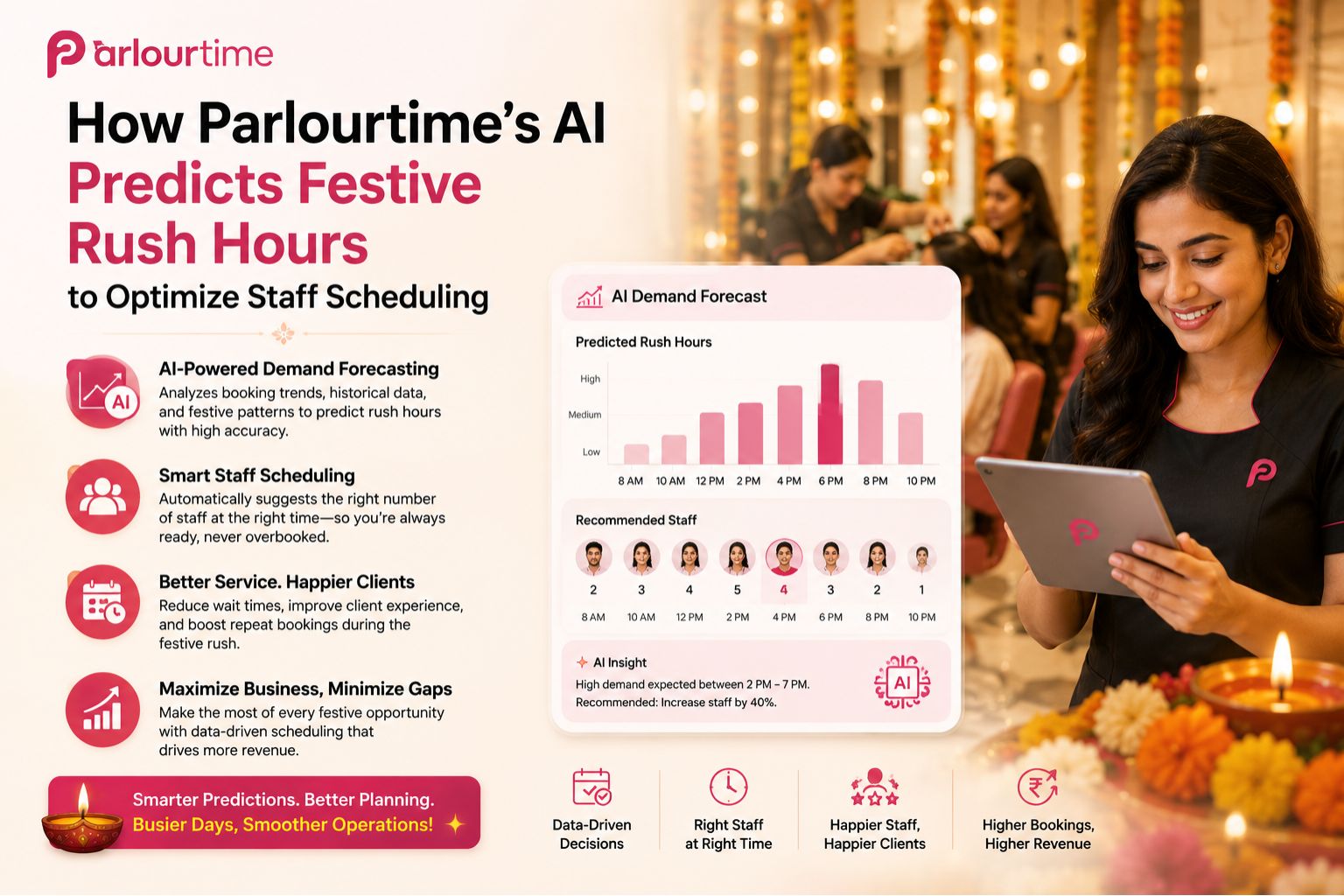


During festive seasons, salons often face unpredictable surges in customer demand, leaving receptionists overwhelmed and stylists exhausted. Or is it more like - wait, we kind of know it's coming but still somehow end up scrambling. Parlourtime's AI system analyzes years of booking data and local event calendars to forecast exact rush hours, ensuring your salon is never understaffed during Diwali or wedding rushes. This technology shifts reactive scheduling to a proactive workflow, eliminating the guesswork that leads to burnout and missed revenue, though honestly, I wonder if it can really capture every last-minute walk-in that shows up.
What Festive Rush Prediction Means for Your Salon Operations
Many salon owners assume they can handle festive crowds through intuition alone, only to discover that real-world patterns are far more erratic, um, like that time we thought "yeah Deepavali is busy" but the actual crowd hit at 11am not 4pm like we guessed. The AI identifies subtle signals, like increased facial booking requests two weeks before a major festival, or a sudden spike in hair smoothening appointments during wedding seasons, which I've noticed myself but never knew how to quantify properly. By mapping these signals against historical staff performance, the system generates precise shift recommendations that prevent chaos at the reception desk, which honestly sounds like a blessing when you've got three phones ringing and a client asking why her appointment is delayed.
Reality Check: How Indian Salons Actually Experience Demand Spikes
In practice, a salon in Hyderabad might see a 40% jump in bridal makeup queries three days before a peak wedding date, while a unisex salon in Delhi faces a different surge pattern around Karva Chauth. Parlourtime's AI accounts for regional festival variations and even local school holidays, which are often overlooked by busy owners like me who rely on "this same time last year" logic. One salon owner noticed that ignoring these micro-trends led to a 25% drop in service quality during Ganesh Chaturthi - I mean, that's a quarter of your clients walking out unhappy - as staff were stretched thin during unexpected peak hours.
Common Scheduling Mistakes That Amplify Staff Dissatisfaction
A frequent blind spot is assuming that adding more staff during a known peak day solves everything, but wait, isn't that what most of us do? Actually, overstaffing during a lull creates idle payroll costs, while understaffing during a true rush leads to razor burn complaints and brow tint disasters, which I've personally dealt with and it's not pretty. Another hidden error is neglecting to align lunch breaks with predicted low-demand windows, causing two stylists to vanish simultaneously when a queue forms, and honestly who hasn't seen that happen during a Saturday rush? These operational gaps directly fuel employee turnover, especially among senior therapists who value predictable routines, though finding reliable staff in this industry is already tough enough.
Decision Help: How to Use AI Scheduling Without Overcomplicating Your Setup
For salon owners evaluating this tool, the key is to start small: feed the AI three months of booking data alongside festival dates from the Parlourtime blog, though I'm a bit nervous about handing over our data like that. The system then outputs a weekly roster that flags high-risk days for no-shows or double bookings - sounds useful, but will my receptionist actually understand the output or just ignore it? The boundary where this service stops working is when a salon refuses to update its digital calendar consistently; stale data yields stale predictions, so if you're still using paper diaries this probably isn't for you. A common misunderstanding is that AI replaces human judgment - yeah, I worried about that too - but in reality, it frees managers to handle urgent client complaints or order supplies, rather than staring at a scheduling spreadsheet.
FAQ
q How does Parlourtime's AI predict festive rush hours without historical data?
a The AI uses anonymized aggregate data from similar salons in your city region plus local event triggers like a nearby mela or award function to build a baseline forecast until your own data matures, though I'm slightly sceptical about how "similar" those salons really are to mine.
q Will the scheduling suggestions work for a small salon with only three stylists?
a Yes the system is designed for teams of 2 to 50 plus it factors in each stylists skill set such as who handles bridal blush versus who specializes in keratin treatments so shifts stay efficient - okay that actually makes sense for my setup where one girl is great with curls but not with cuts.
q What happens if a festival date shifts or a sudden power cut changes customer flow?
a The AI updates in real time based on check in data and if a crisis hits it sends alerts to the manager via the app allowing manual overrides within minutes, provided someone actually checks the app during a power cut of course.
q Can I integrate Parlourtime's AI scheduler with my existing POS or booking software?
a Parlourtime offers API integration with most common salon management platforms reducing duplicate entry work and ensuring your staff roster remains synced across systems, but I'll need to check with our software guy first because integration always sounds simpler than it actually is.